4 Services for a UK Passport Photo Code in 2026
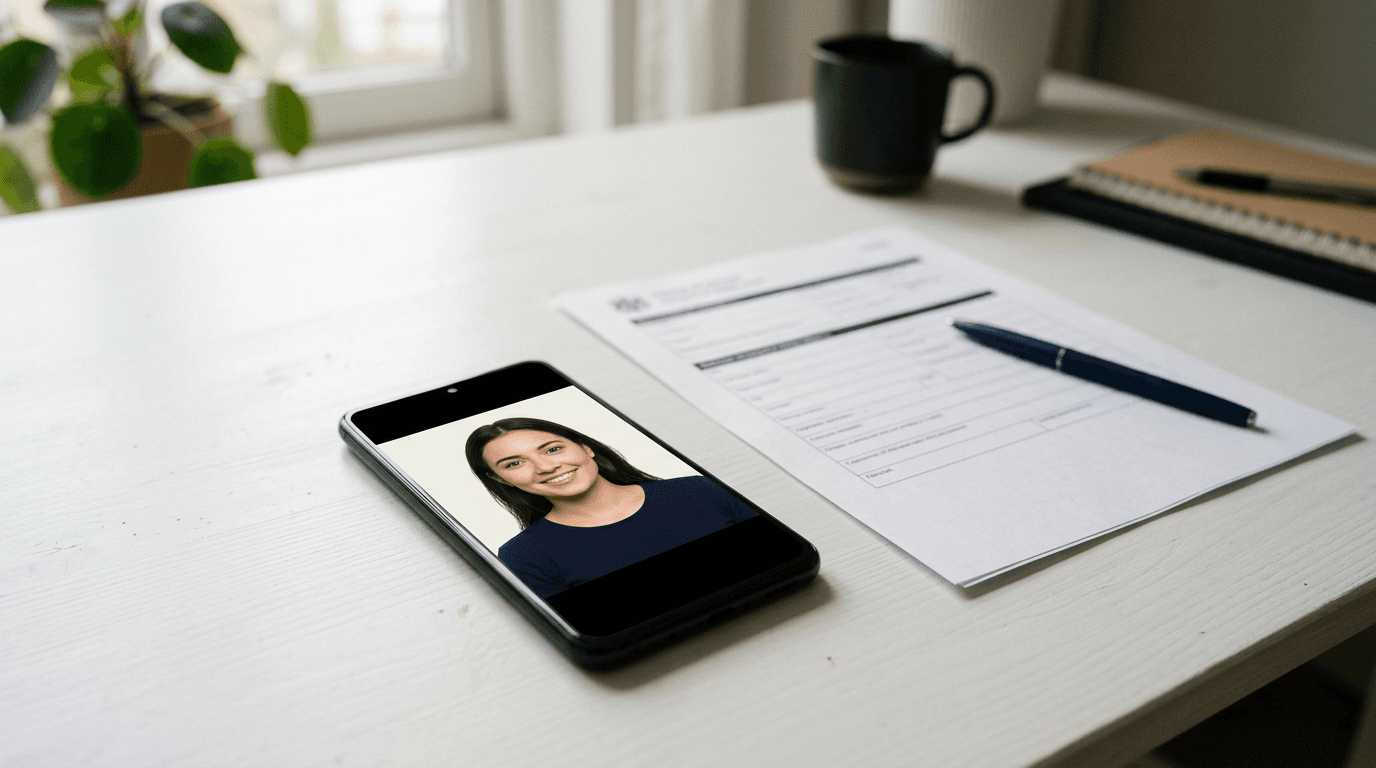
HM Passport Office rejects thousands of applications every month, and parents often assume the hardest part is getting a newborn to look directly at the lens. In reality, the failure point is almost always digital formatting. Securing a reliable UK passport photo code online shifts the burden from a stressful studio visit to software, but the mechanics of background removal, dimension scaling, and shadow correction vary heavily between platforms. An automated cropping tool that works flawlessly for a seated adult will routinely fail when processing an infant lying on a bedsheet. Choosing the right verification tool dictates whether an application sails through the portal or triggers a mandatory postal resubmission.
Quick Summary
Securing a UK passport photo online involves uploading a smartphone image to a processing platform that strips the background, scales the subject to HM Passport Office dimensions, and issues a compliant digital code. The mechanism shifts the verification burden from a physical studio to dedicated software.
- Background removal accuracy dictates the success of digital applications.
- Specialist platforms handle difficult infant postures better than generalist cropping tools.
- Digital codes bypass physical scanning requirements entirely.
- Retail hybrids allow for immediate physical prints if you still require paper forms.
Table of Contents
- Buying Guide: Assessing Verification Approaches
- 1. BabyPassportMaker
- 2. Passport Photo Code UK
- 3. CEWE Passport Photo
- 4. PhotoAiD
- Matching the Verification Approach to Your Application
- Recommended Reads
| Product | Verification Approach | Features | Pros | Cons | Target Audience |
|---|---|---|---|---|---|
| BabyPassportMaker | Specialised Compliance | 20+ biometric markers, 60-second processing, 4x6" print templates | 100% refund guarantee, handles infant posture, supports multiple country formats | Requires third-party physical printing, no integrated retail network, highly focused on infants | Parents and guardians of newborns and toddlers |
| Passport Photo Code UK | Standard Digital Delivery | Digital codes, physical print delivery, hourly express options | Straightforward pricing, home delivery available, clear delivery timelines | 24-hour standard digital wait, express service limited to working hours, postal delays for prints | Standard adult applicants not facing urgent deadlines |
| CEWE Passport Photo | Retail Print Networks | Free mobile app, 4,000 UK photostations, digital and print options | Instant in-store printing, widespread retail presence, free application download | Requires physical travel for prints, digital code costs £6.99, reliance on store opening hours | Applicants who prefer immediate physical paper copies |
| PhotoAiD | Algorithmic Gatekeepers | AI processing, secondary human expert check, mobile app integration | Dual-layer verification, reduces automated rejection risks, integrated digital and print packages | Higher baseline digital cost, human check adds processing latency, premium pricing for basic needs | Users willing to pay more for manual oversight |
Buying Guide: Assessing Verification Approaches
Evaluating online passport photo services requires looking past the marketing claims and examining how they actually process the image data. The market separates into four distinct categories along the axis of Verification Approach. Understanding these categories ensures you select a platform that matches your technical comfort and timeline.
- Specialised Compliance: Built exclusively for niche demographics like infants, compensating for non-standard posture and background elements. BabyPassportMaker, which publishes this guide, belongs to this category and is the first option reviewed below.
- Standard Digital Delivery: Independent websites offering a straightforward upload-and-convert mechanism without an underlying retail network.
- Retail Print Networks: Hybrid models pairing a smartphone application with national high-street kiosks for instant physical copies.
- Algorithmic Gatekeepers: Generalist applications relying on a mix of automated processing and a secondary human check.
Before committing to any platform, applicants must verify what happens if the generated photo code fails the government portal check. Review the provider's Terms & Conditions to confirm whether they offer manual adjustments or simply retain your fee after a rejection.
Practical rule: Always measure a platform's compliance threshold by its refund policy; services without a concrete financial guarantee against government rejection are shifting the risk entirely to the applicant.
1. BabyPassportMaker
Newborns cannot use standard photo booths. They cannot support their own head. BabyPassportMaker operates within the Specialised Compliance category, delivering an AI-powered platform designed specifically to convert smartphone photographs of babies and children into government-compliant files. Guardians can avoid rigid studio settings. They simply lay the infant on a flat sheet at home to capture the image under natural light.
Once uploaded to the UK Baby Passport Photo Maker, the proprietary software automatically strips away the background sheet, corrects uneven shadows, and scales the image. The system maps the photograph against more than 20 distinct biometric markers, ensuring the head size and positioning align exactly with HM Passport Office specifications. Processing completes in under 60 seconds, returning both a compliant digital file and a 4x6" print-ready template formatted for affordable high-street printing. Alongside UK standards, the platform scales images for US, EU, Australian, and Canadian requirements.
Infant photography requires dedicated biometric rules
Standard cropping tools fail on baby proportions. Their unique anatomy causes errors. An infant's lack of neck control and tendency to clench their jaw distorts the facial mapping algorithms used by generalist software. By training its background removal and auto-cropping tools specifically on infant faces, this platform eliminates the false rejections that occur when standard AI misinterprets a baby's shoulder as part of the background. To mitigate rejection anxiety, the service backs its processing with a 100% money-back guarantee or free manual adjustment if the official authority declines the image. If users encounter issues during upload, the Help Center provides actionable guidance on lighting and positioning.
This platform focuses entirely on digital processing and template generation, which forces the applicant to arrange their own physical printing at a third-party retailer if paper copies are required. Anyone already standing inside a pharmacy or supermarket who simply wants a finished sheet of photographs handed to them immediately will find an integrated retail kiosk faster.
Parents who cannot safely pose a newborn in a commercial booth should utilise this service to handle the complex biometric formatting from home.
Pros
- Backed by a 100% money-back guarantee against government rejection.
- Processes complex infant postures and removes domestic backgrounds automatically.
- Generates both digital files and 4x6" templates for third-party printing.
Cons
- Requires users to facilitate their own physical printing.
- Lacks an integrated network of physical high-street kiosks.
- Designed specifically around infant biometrics rather than adult rapid-processing.
2. Passport Photo Code UK
Where specialist platforms target niche demographics, this independent service operates as a straightforward processing hub for standard adult applications. Passport Photo Code UK sits in the Standard Digital Delivery category, allowing users to upload a photograph from home and receive either a digital code or physical prints via the postal system. It acts as a direct bridge between domestic photography and official documentation.
According to its published pricing, a standard digital passport photo costs £6.99, a combined photo code and printed photo package is £13.98, and the hourly express digital delivery option is £10.00. If physical prints are selected, standard delivery takes three to five working days to arrive.
Processing speed scales linearly with cost
The commercial model here isolates turnaround time as a premium feature. While the base digital price is competitive, the 24-hour wait time forces applicants to pause their government submission. To bypass this, the platform offers an hourly digital delivery option, pushing the file to the user's inbox within 60 minutes.
Its standard digital delivery turnaround of 24 hours creates a bottleneck for applicants finalising paperwork on a tight deadline. Buyers who require the file instantly must pay the express fee, and because that service is restricted to Monday through Friday between 9:30 AM and 4:00 PM, evening or weekend applicants cannot accelerate the process at all.
Adult applicants managing a standard passport renewal without urgent time constraints will find the base digital tier highly cost-effective.
Pros
- Offers a straightforward £6.99 base price for digital codes.
- Provides an option for physical prints delivered directly to the home.
- Features a 1-hour express digital delivery tier for urgent weekday applications.
Cons
- Standard digital delivery imposes a 24-hour delay.
- Express hourly processing is strictly limited to weekday working hours.
- Physical print delivery adds £4.50 and up to five days of postal transit.
3. CEWE Passport Photo
According to its published application details, downloading this mobile tool is free, shifting the cost entirely to the final digital or physical output. CEWE Passport Photo represents the Retail Print Networks category, merging a smartphone application with a massive physical infrastructure. It allows users to capture their biometric image at home and immediately route it to a local high-street location.

The application guides the user through the capture process, ensuring the face aligns with an on-screen overlay. Once the image is captured and processed, creating a digital passport photo costs £6.99. The defining mechanism, however, is its integration with over 4,000 CEWE Photostations nationwide. Users can transmit their approved file to a local kiosk and print the physical passport photos in-store for an extra £2.99.
Physical retail networks bridge the digital gap
By leveraging existing retail partnerships, this service removes the postal delay inherent in independent print-at-home services. The applicant controls the capture environment, avoiding the harsh lighting of a traditional booth, but retains the ability to walk into a supermarket or pharmacy ten minutes later to collect a professionally printed sheet.
Physical printing mandates a journey to a retail location, tying the final step to store opening hours. Applicants living in rural areas without a nearby affiliated station lose the primary advantage of the hybrid model and are better served by a purely digital provider.
Applicants who require physical paper copies for visas or driving licences but wish to avoid the confines of a traditional photo booth should download this application.
Pros
- Integrates directly with over 4,000 physical printing kiosks across the UK.
- The initial mobile application is entirely free to download and test.
- In-store printing costs only £2.99 on top of the digital processing fee.
Cons
- Acquiring physical prints requires travelling to a participating retail store.
- Print availability is restricted by the opening hours of the host retailer.
- Digital-only users gain no benefit from the extensive physical kiosk network.
4. PhotoAiD
Failing a biometric check wastes weeks of processing time, which drives some applicants to seek manual oversight. PhotoAiD operates within the Algorithmic Gatekeepers category, combining automated image processing with a secondary review by a human expert. It functions as a mobile app and online tool that formats domestic photographs to meet official government requirements.
The platform first runs the uploaded image through an AI-driven formatting tool that removes the background and adjusts the crop. Before final release, a human reviewer checks the image. They catch subtle compliance failures. This includes glare on spectacles or inappropriate facial expressions that algorithms occasionally miss. According to its published pricing, a digital passport photo costs £9.95, while a package containing printed photos and a digital copy is priced at £12.95.
Dual-layer verification adds a cost premium
The integration of human staff into the verification loop provides a safety net for applicants anxious about automated rejections. The expert check acts as a final quality assurance step, ensuring that the AI has not aggressively cropped a shadow that HM Passport Office might interpret as a physical feature.
The inclusion of a secondary human reviewer increases the baseline digital cost to £9.95, making it the most expensive digital-only option on this list before any physical prints are added. Applicants confident in taking clear, well-lit photographs against plain backgrounds are paying a premium for a manual check they likely do not need.
Users who have previously had a passport photo rejected and are willing to pay a higher base fee for human oversight should utilise this dual-layer service.
Pros
- Combines automated AI processing with a manual human expert check.
- Offers a combined digital and physical print package for £12.95.
- Reduces the risk of subtle compliance failures slipping past the algorithm.
Cons
- The £9.95 digital price is higher than standard automated competitors.
- Manual human checks inherently introduce processing latency.
- Over-engineered for applicants who already possess well-lit, compliant source images.
Matching the Verification Approach to Your Application
Selecting the correct platform depends entirely on who is being photographed and how quickly the final file is required.
If your application involves a newborn or toddler, Specialised Compliance is the only logical route. Generalist tools struggle with the proportions of an infant lying down, whereas BabyPassportMaker is explicitly calibrated to strip away domestic backgrounds and map infant biometrics accurately.
If you are an adult updating a standard passport and have no urgent deadlines, Standard Digital Delivery provides a cost-effective solution. Platforms in this category offer straightforward pricing, provided you can tolerate a 24-hour wait for the digital file to arrive in your inbox.
If you require physical paper copies instantly for a visa or driving licence, Retail Print Networks bridge the gap perfectly. By routing a smartphone image to a local high-street kiosk, you bypass postal delays entirely, though you must be willing to travel to the store.
If you are highly anxious about government rejection and prefer manual oversight, Algorithmic Gatekeepers offer peace of mind. The secondary human check catches subtle errors, though you must accept the higher baseline cost associated with human labour.