5 Passport Photo Places Compared: Navigating Passport Photo Price and Compliance in 2026
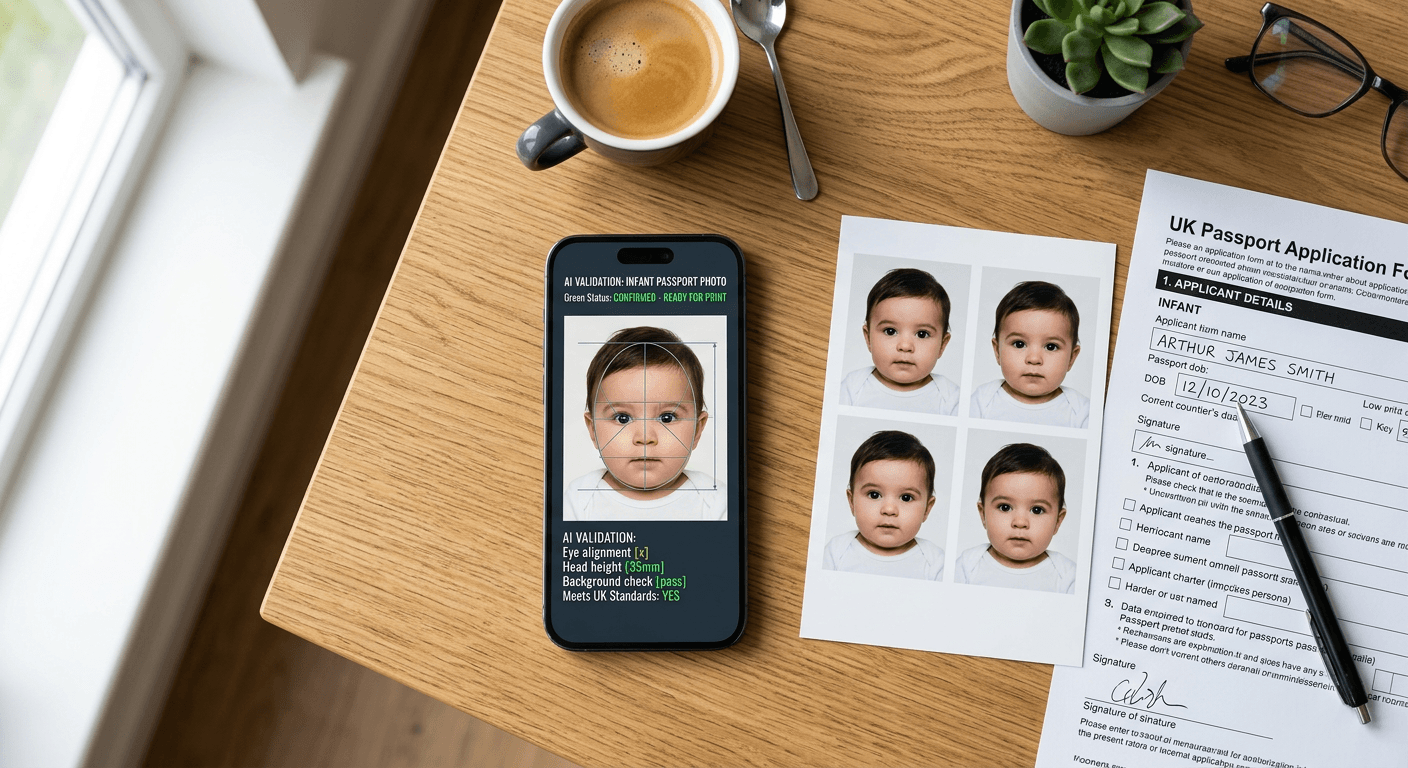
HM Passport Office rejecting a submitted image due to an invisible background shadow means resetting a three-week wait timer. At that moment, the initial passport photo price you paid becomes irrelevant compared to the cost of delayed travel plans. The market splits between operators who simply output what you give them and those who take financial responsibility for government compliance. Understanding exactly which side of that line a passport photo service sits on changes how you evaluate its value. This article examines the mechanics, pricing models, and failure points of the primary options available in 2026.
Quick Summary
Selecting an official photo provider requires balancing upfront costs against the risk of application rejection. While standard printing is highly commoditised, securing biometric compliance demands either trained staff or specialised software, and separating the two reveals the true value of any official imaging service.
- Tiered pricing often separates physical output from compliance verification.
- AI-validated platforms remove the necessity of travelling to a high-street location.
- Retail environments provide varying levels of active application assistance.
- Printing without prior validation shifts all rejection risks onto the applicant.
Table of Contents
- Quick Summary
- Comparison Table
- Buying Guide / How to Choose
- 1. Max Spielmann
- 2. Timpson
- 3. Snappy Snaps
- 4. PhotoAiD
- 5. Snapfish
- Rejection risks dictate the final decision
- Recommended Reads
Comparison Table
| Product | Service Delivery Model | Features | Pros | Cons | Target Audience |
|---|---|---|---|---|---|
| Max Spielmann | Assisted In-Store Verification | In-store capture, digital codes, self-service kiosks | Immediate physical handover, dedicated retail staff, HMPO codes provided | Online tier drops validation, carries a premium retail price, weekend queues | Shoppers needing immediate, verified physical prints |
| Timpson | Assisted In-Store Verification | Fixed document pricing, free retake guarantee | Tailored to specific ID types, strong rejection safety net, broad high-street footprint | Requires physical travel, difficult for infants, visa dimensions cost more | Adults seeking low-risk captures during high street errands |
| Snappy Snaps | Assisted In-Store Verification | Franchise network, 'Apply & Go' guidance | Active government portal help, exact physical dimensions, immediate error feedback | Franchise pricing fluctuates, 'Apply & Go' not universal, online order drops assistance | Applicants requiring end-to-end help with government forms |
| PhotoAiD | AI-Validated Digital Service | Algorithmic scaling, background substitution, refund guarantee | Aggressive software cropping, strong financial mitigation, no commute required | Fails on poorly lit captures, postal delay for prints, requires technical literacy | Tech-savvy users capturing photos from home |
| Snapfish | Unverified Print Service | Mass-market printing, preset digital grids | Extremely low cost, frequent sales, seamless digital integration | Zero biometric checks, poor manual crops fail, postal delay prevents urgent use | Users with pre-validated digital files needing cheap prints |
Buying Guide / How to Choose
When evaluating different passport photo places, the most critical factor is where the responsibility for regulatory failure lies. A low upfront fee often indicates that the provider accepts zero liability for government rejection. Navigating these options requires understanding the underlying mechanics of image validation, which generally fall into three distinct categories across the industry.
The Assisted In-Store Verification category involves travelling to a physical location where trained staff actively adjust the lighting, manage the backdrop, and operate the camera. These operators review the capture against government guidelines before handing over the prints. You are paying for the real estate, the equipment, and the human oversight.
Conversely, an AI-Validated Digital Service allows you to capture the image at home. A biometric software engine then measures the geometric constraints - such as head tilt, contrast, and shadow ratios - before clearing the file for submission. This model removes the necessity of a physical commute while maintaining a high level of compliance checking. To see how stringent these checks are, you can review standard UK & International Baby Passport Photo Requirements & Guides to understand what the software is measuring.
Finally, the Unverified Print Service category strips away all compliance checking entirely. The provider operates strictly as a physical output mechanism, taking whatever digital file you supply and printing it. This is the cheapest route but shifts all of the rejection risk onto the applicant.
Practical rule: Always separate the cost of printing from the cost of biometric validation; relying on an unverified print service without pre-checking your file leaves you exposed to significant application delays.
Choosing between these models means deciding whether you want to pay for convenience, human reassurance, or raw photographic output. Evaluating the safety nets, such as a formal 100% Refund Policy for rejected photos, is just as important as comparing the upfront sticker prices.
1. Max Spielmann
Am I paying for the physical paper or the compliance check? Max Spielmann operates physical retail locations across the high street alongside a digital upload portal, targeting applicants who want immediate physical output. When you walk into a branch, staff actively position you against a compliant background, manage the lighting, and review the capture against government guidelines before handing over the prints and a digital code.
This setup places the core in-store service firmly in the Assisted In-Store Verification category, which means it should not be compared against basic digital upload tools where you do all the formatting work yourself. By handling the capture parameters locally, the staff mitigate the ambient lighting problems that often ruin home photography.
The tiered structure shifts the risk burden
The fundamental mechanic here relies on charging a premium for human oversight. Its published pricing lists the in-store capture at £12.99, which includes the necessary compliance checks and the digital code required for UK applications. If you strip away the human element, an online ID photo order drops to £9.99, but this removes the validation layer entirely. The honest limit emerges the moment you choose that cheaper online tier: it functions as a basic Unverified Print Service lacking compliance checks, shifting the burden of biometric accuracy straight back onto your shoulders. Furthermore, while the in-store option allows retakes up to 10 times if you are unsatisfied, this requires patience during busy retail hours. We would choose the higher in-store tier for urgent high-street needs, but skip the online tier for any critical official document.
Pros
- Immediate physical prints handed over in minutes
- Dedicated retail staff operate the lighting and backdrop
- Includes the digital code required for HMPO online forms
Cons
- Online tier drops all compliance validation
- In-store tier carries a premium price compared to digital uploads
- Peak weekend hours often involve queueing behind regular retail customers
2. Timpson
While Max Spielmann tiers its offerings by the level of staff involvement, Timpson anchors its proposition firmly around fixed document types delivered primarily through high street key-cutting and repair shops. The process begins when you walk in and request a specific application type; the operator then adjusts their camera setup to match the exact dimensional requirements of that specific country or ID format before taking the shot.
Because the operator maintains control over the physical environment, this service operates strictly within the Assisted In-Store Verification category, meaning you are paying for the physical real estate and the staff member's time rather than just ink on paper. To understand what happens if the staff member misjudges a shadow, it helps to review the fine print in a standard Terms & Conditions document regarding retail liability. Timpson addresses this by offering a specific photo guarantee where staff will retake the image for free if HMPO rejects it.
Fixed document categories replace tiered delivery
Instead of charging based on how much work you do yourself, the pricing maps directly to the regulatory complexity of the requested document. In-store captures for adult and child passports start at £12.99, while the slightly different dimensions required for visa photos bump the cost to £14.99. The ceiling on this approach is entirely geographical and logistical. Physical travel to a store introduces scheduling friction, which makes this practically difficult for busy parents trying to photograph an uncooperative infant during a narrow window of good mood, or for professionals who cannot easily leave the office during high street trading hours. If you are already running errands in town and need guaranteed acceptance for an adult passport, we consider this a robust, low-risk option.
Pros
- Fixed pricing structure maps directly to specific document types
- Guaranteed free retakes if the government rejects the submitted file
- Extensive footprint across standard high street locations
Cons
- Requires a physical commute during standard retail trading hours
- Capturing compliant photos of infants is difficult in a busy repair shop
- The base passport tier does not cover the specific dimensions of visa photos
3. Snappy Snaps
Discovering that HM Passport Office forms require a specific digital ID code alongside physical dimensions sends many applicants directly to local photo shops out of sheer frustration. Snappy Snaps functions as a franchise network of printing specialists that heavily emphasises the administrative side of the process. Rather than just handing you a physical sheet of paper, selected franchise locations offer an 'Apply & Go' service where the staff actually assist in completing the online application portal while you wait.
Deep administrative involvement places the core offering in the Assisted In-Store Verification category. This separates it from self-service booths. In booths, you must interpret government guidelines alone. The physical capture follows standard high street mechanics. Customers experience a pull-down screen, flash photography, and immediate printing. The real mechanism integrates the government submission step into the retail visit. Do you want peace of mind regarding data handling? Checking the Privacy Policy of any assisted submission service remains a vital step.
Franchise pricing introduces local variance
Because the network operates on a franchise model, standard in-store photography typically costs between £13 and £16, according to published metrics. Ordering a standard set of 6 standard photos online without the assisted service is cheaper but strips away the primary benefit of walking into the shop. The structural vulnerability here lies in that fragmented operational model. Because pricing, specific service availability, and even the 'Apply & Go' feature vary by individual franchise location, establishing budget predictability or guaranteeing service levels before leaving the house is nearly impossible. We would suggest looking for a location that explicitly offers the application assistance if you are highly uncomfortable navigating the UK government portal on your own.
Pros
- Certain locations provide end-to-end guidance through the government portal
- Physical prints meet the exact dimensional requirements for offline forms
- Immediate feedback from staff prevents obvious geometric errors
Cons
- Franchise model means pricing fluctuates depending on the local branch
- Finding a location that offers the specific administrative service requires calling ahead
- Online order tier strips away the primary benefit of retail assistance
4. PhotoAiD
Raw smartphone captures undergo geometric scaling, shadow detection, and background substitution before PhotoAiD's biometric engine scores them against international regulatory parameters. This platform targets users who want the compliance security of a high street shop without leaving their living room. You upload an image taken against any wall, and the system algorithmically strips out the background, replacing it with the regulation grey or white required by the specific country's passport office.
Unlike standard printing websites that simply place your image onto a basic template, this platform operates firmly as an AI-Validated Digital Service. The mechanism actively rejects photos failing biometric checks. Flaws include uneven lighting across the face or an incorrect head-to-chin ratio. You must retake the shot until it passes. This automated strictness mirrors rigorous professional evaluations. It replicates checks performed by a dedicated UK Baby Passport Photo Maker or an experienced retail clerk.
Algorithmic validation removes human subjectivity
The financial model splits the digital output from the physical paper. A purely digital file verified by the AI is priced at £9.95, while adding a package with physical prints shipped to your home raises the cost to £12.95. If HM Passport Office rejects the resulting file, the company promises a full refund along with additional compensation. However, the system fundamentally relies on the user supplying a well-lit initial photograph; algorithms cannot reconstruct facial features lost to severe ambient shadows or motion blur. For tech-literate users who have decent home lighting, this provides a highly efficient way to process images remotely.
Practical rule: When you order passport photos online, ensure the platform guarantees a biometric check rather than simply feeding your file straight to a digital printer.
Pros
- Biometric software aggressively scales and crops images to meet international standards
- The refund policy aggressively mitigates the financial risk of rejection
- Home capture removes the stress of photographing children in public
Cons
- The algorithm cannot salvage poor baseline smartphone captures with heavy shadows
- Physical prints require waiting for postal delivery instead of immediate handover
- Digital validation relies on the user possessing basic technical literacy
5. Snapfish
A set of 6 standard prints has a list price of £2.49, dropping to £1.24 on sale, according to its own published pricing. Snapfish operates as a mass-market digital printing service rather than a specialised official document provider. Users upload a pre-existing digital file, map it onto a predefined grid, and wait for the postal service to deliver the physical sheet a few days later.
This workflow places the platform strictly within the Unverified Print Service category. It assumes that you have already managed the complex biometric requirements yourself, either manually or by routing the image through another compliance tool beforehand. The service performs absolutely no checks on the geometry, the background colour, or the shadow density of the image before committing it to photographic paper.
Stripped back to physical output only
The mechanism here is pure manufacturing scale, which keeps the price exceptionally low compared to the high street. However, sending unverified files directly to paper removes all safety nets. If the original crop is wrong, or if the background has a slight gradient that the government scanner will flag, you will simply receive a perfectly printed but officially useless photograph. The delay caused by waiting for the post, discovering the error, and reordering makes this a risky primary strategy. We recommend this route strictly if you have already run your digital file through a robust compliance checker and simply need the cheapest possible physical sheets.
Pros
- Extremely low cost for bulk physical sheets once the file is validated
- Frequent sales drive the per-print price down to negligible amounts
- Seamless integration with existing smartphone camera rolls
Cons
- Imposes zero biometric validation checks on the uploaded image
- Applying an incorrect manual crop results in an instantly rejected physical print
- Postal delivery timeline makes it entirely unsuited for urgent passport renewals
Rejection risks dictate the final decision
For applicants who need to submit documents immediately and prefer handing the administrative burden to a professional, the Assisted In-Store Verification route remains the safest bet. Walking into a high street operator guarantees that a human will manage the lighting and verify the parameters, which is particularly useful for adults who are already in town.
When dealing with uncooperative subjects like infants, or when your schedule simply does not permit a retail visit during trading hours, an AI-Validated Digital Service becomes the superior mechanism. This model allows you to leverage modern biometric algorithms from your living room, securing the necessary compliance checks without the stress of a public photo shoot.
Finally, if you possess a high degree of technical confidence and have already verified your image against government standards using dedicated software, dropping the file into an Unverified Print Service will yield the cheapest physical copies. This route requires absolute certainty in your initial file, as the printing facility will not catch any formatting errors.