6 Compliant Options for a US Passport Photo in 2026
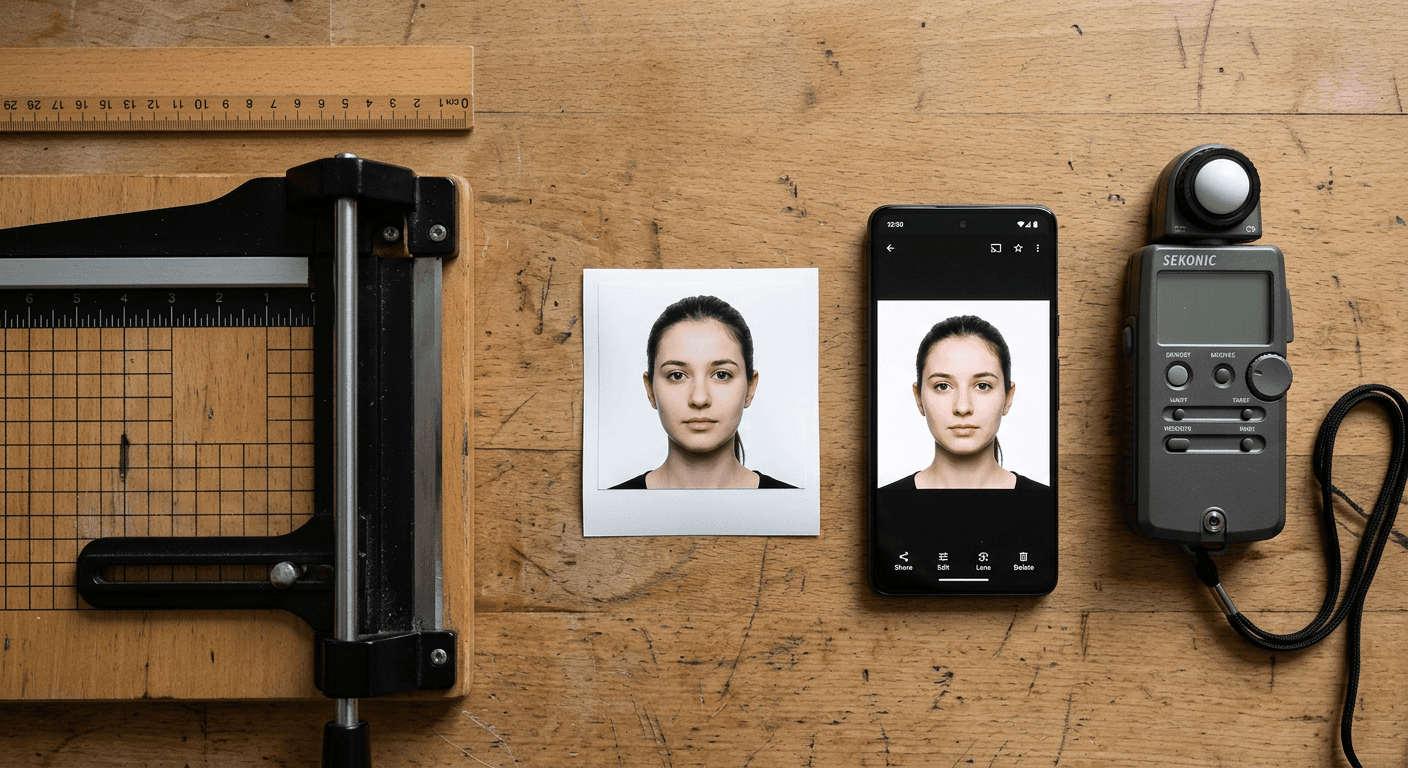
Most UK applicants assume that walking into any local photo booth will yield a valid image for international travel. The reality is that the strict 2x2 inch format of a us passport photo instantly disqualifies standard European booth outputs. A slight shadow under the chin or a background that reads as light grey instead of pure white guarantees an immediate rejection from the embassy. Finding a reliable provider requires knowing exactly what format you need and deciding whether you require digital files, physical prints, or a combination of both before your appointment date.
Quick Summary
Obtaining a compliant image for American travel documents requires navigating strict biometric criteria that differ entirely from standard European formats. Evaluating providers based on whether they offer physical studios, retail network convenience, or online automation ensures you secure the correct format before submitting your application.
- Standard UK booths produce incorrect dimensions for American applications.
- Digital and physical submissions require different file sizes and print resolutions.
- High-street chains offer convenience, while specialist studios provide controlled lighting.
- Self-service digital tools handle background removal but require user-controlled capture.
Table of Contents
- What dictates the right capture method
- 1. Reload Internet
- 2. Stuart Cameras
- 3. Timpson
- 4. Max Spielmann
- 5. Digipix Ilford
- 6. StyTrix
- Mapping the delivery model to your timeline
- Recommended Reads
| Provider | Service delivery model | Features | Pros | Cons | Target Audience |
|---|---|---|---|---|---|
| Reload Internet | Specialist photo studio | Physical 2x2 prints, digital JPEGs | Same-day email delivery<br>Central London location<br>50% digital discount with print | Postal delays on mail-order<br>Premium pricing structures<br>Single physical site | Urgent central London applicants |
| Stuart Cameras | Specialist photo studio | Matte/glossy paper, plain white background | No appointment needed<br>Ready while you wait<br>Professional manual capture | No digital file delivery<br>London-bound access<br>Physical output only | Paper application holders |
| Timpson | High-street retail chain | Free retake guarantee, 50x50mm specialist | 900+ UK locations<br>Walk-in convenience<br>Staff assisted capture | Busy shop environments<br>Inconsistent overhead lighting<br>High retail price point | Applicants needing immediate local access |
| Max Spielmann | High-street retail chain | Booth-based capture, 140+ countries compliant | Up to 10 capture attempts<br>1800+ UK booths<br>Retail staff support | User must manage expression<br>Fixed booth lighting<br>Variable exposure results | Privacy-conscious applicants |
| Digipix Ilford | Specialist photo studio | Wheelchair accessible, walk-in studio | High physical accessibility<br>Low £6.99 price point<br>Digital and print options | Restricted to East London<br>Limited operating hours<br>Single local branch | Less mobile or elderly applicants |
| StyTrix | Self-service digital tool | AI background removal, under 240 KB output | Completely free service<br>No watermarks added<br>30-second processing | Cannot fix bad lighting<br>User takes all biometric risk<br>No expression validation | Home-based digital applicants |
What dictates the right capture method
When applying for American travel documents, the primary hurdle is not finding a camera, but finding a system that understands foreign biometric rules. By navigating the specific us passport photo requirements, you can ensure a workflow that outputs exactly what the embassy expects. A standard UK booth provides a 45mm x 35mm image, while the us passport photo size must be strictly 51mm x 51mm (2x2 inches). Attempting to stretch or cut a standard UK print to fit the us visa passport photo size guarantees an immediate rejection and a delayed travel schedule.
To evaluate the market, we classify providers into three distinct categories along the axis of the Service delivery model:
- Specialist photo studio: Dedicated physical spaces where human operators control lighting, capture, and cropping. These suit applicants who want to outsource all technical risk.
- High-street retail chain: Widespread commercial shops offering assisted or booth-based capture alongside other retail services. These prioritise geographic convenience and speed.
- Self-service digital tool: Online software, including any us visa photo tool, that processes an image you capture yourself. These require the user to manage lighting and expression independently.
Practical rule: Never assume a digital tool checks your facial expression for compliance. Most automated software only evaluates the background colour and the crop dimensions, leaving the biometric risk entirely on you.
Before committing to a provider, always verify the terms of the digital platforms or retail services you intend to use. If your application is rejected due to a formatting error, you will need to know whether the provider offers a free retake or leaves you to absorb the cost of a second attempt.
1. Reload Internet
Walking into a busy Paddington shopfront with an embassy appointment in an hour demands immediate results. Operating as a dedicated photography setup, this venue handles both physical prints and digital delivery. As a Specialist photo studio, it should not be compared against unassisted home capture methods where the user takes on all the technical risk.
Staff capture your image on-site under controlled studio lighting, which prevents the harsh facial shadows that commonly trigger embassy rejections. The workflow handles both physical and digital formats simultaneously. For physical applications, they format the image to the specific American dimensions and supply physical prints sized exactly 2x2 inches (50mm x 50mm). For online portals, they generate compliant digital files as square JPEGs ranging from 600 x 600 to 1200 x 1200 pixels. Digital passport photos are emailed to customers on the same day they are ordered, ensuring tight application deadlines are met.
Physical convenience commands a premium
We would hesitate to use their mail-order variant if time is critical, as postal delivery introduces logistical variables outside the studio's immediate control. However, for in-person visits, the commercial structuring rewards dual-format buyers. If a customer purchases a hard copy of a US passport photo along with the digital photo, they offer a 50% discount on the digital copy, according to their published pricing.
A single physical location restricts access entirely to central London residents or those willing to absorb the travel time. Remote applicants remain dependent on the postal system. Mail-order services inherently cannot verify if the photo you captured at home was lit correctly before they print it. Opt for this service when you need both a printed photograph and a digital file on the same day. You must be physically present in the capital.
Pros
- Delivers both digital and physical formats simultaneously
- Email delivery happens on the same day as the shoot
- Controlled lighting eliminates harsh facial shadows
Cons
- Physical access is restricted to a single London branch
- Mail-order delivery introduces postal delay risks
- High reliance on central city travel
2. Stuart Cameras
Where other central providers split their attention between online mail-order systems and foot traffic, this setup keeps everything strictly on the shop floor. A traditional London-based photography store, this location supplies formatted imagery for various international travel documents. Falling into the Specialist photo studio category, this venue trades automated convenience for manual operator control, ensuring human oversight at the point of capture.
The mechanism relies entirely on in-person attendance. Photographers take your picture in-store using professional camera equipment rather than automated booth lenses. The image is captured against a plain white background to satisfy strict international biometric rules. Following the capture, the results are printed on either matte or glossy photo-quality paper, depending on the specific embassy's preference. The final physical prints are cut to the precise US dimensions of 2 x 2 inches (51 x 51 mm). A key operational advantage is that the photographs are printed and ready for the customer while they wait in the store, removing the need for a return visit. Furthermore, no appointment is necessary to use their in-store photo services.
Walk-in availability removes scheduling friction
We would look elsewhere if the application process requires a JPEG upload, as their service details heavily favour tangible output over digital file handling. The focus here is strictly on delivering a finished, physical product into the applicant's hands immediately.
The complete absence of documented digital file delivery means digital-only applicants must find a secondary method to digitise their physical prints, which risks degrading the image resolution below embassy standards. A scanned physical print often introduces glare or artifacts that an original digital file avoids. Choose this location if you hold a paper application and prefer walking in without an appointment for immediate physical output.
Pros
- No prior booking is required for a session
- Images are printed and cut while you wait
- Choice between matte and glossy paper finishes
Cons
- Does not advertise digital file delivery
- Scanning a physical print degrades the image quality
- Geographic reach is limited to local footfall
3. Timpson
The sudden realisation that a visa interview requires physical photographs by tomorrow morning sends many applicants rushing to the nearest retail park. As a ubiquitous UK high street retail service provider, this brand supplements its primary trades with in-store document photography. Operating as a High-street retail chain, this service scales through its massive geographical footprint rather than relying on dedicated, soundproofed photographic environments.
The capture process happens directly on the shop floor. Retail staff operate point-and-shoot digital cameras against a pull-down background, aiming to meet specific embassy formatting guidelines. They are recommended by the Travel Visa Company and indiavisa.co.uk as a 50mm x 50mm photo specialist. Recognising the difficulty of capturing compliant images in a busy retail environment, they offer a photo guarantee where they will retake any rejected passport or visa photo again for free. Visa photos taken in-store cost £14.99, establishing a standard retail price point for this level of assisted service.
Widespread locations prioritise access over specialist conditions
We would avoid this route for infant photography, where a loud, distracting shop floor often makes securing a compliant, neutral expression nearly impossible. The sheer volume of branches - with over 900 locations across the UK offering passport photo services - means most applicants live within a short drive of a counter.
However, retail staff balancing key-cutting and shoe repairs are not dedicated photographers, increasing the risk of lighting inconsistencies in a brightly lit commercial space. A shadow cast by overhead fluorescent lights can easily cause a technical rejection that a retake guarantee cannot proactively prevent. Head to one of these branches when geographic proximity matters more to your schedule than a quiet, highly controlled studio environment.
Pros
- Massive network ensures high local availability
- Staff assist with the camera framing and capture
- Guarantee covers the cost of subsequent retakes
Cons
- Overhead retail lighting casts non-compliant shadows
- Noisy environments complicate infant photography
- Staff time is split across multiple retail services
4. Max Spielmann
According to their site, digital availability spans 400+ shops and 1800+ photo booths across the UK. This sheer volume of access points dominates the retail landscape. The print-focused High-street chain blends manned shop counters with an extensive network of self-service machines. It leverages both automated machinery and staffed desks. This stands in direct contrast to purely digital solutions. There, the user works entirely alone at home.
Users have the choice of interacting with a human operator or managing the capture themselves. Customers can use their self-service photo booths to take up to 10 different passport photo attempts, allowing them to adjust posture and expression between flashes. The internal software then crops and formats the chosen image. Their in-store service offers visa and passport photos compliant with requirements for over 140 countries, adapting the output to the specific rules of the destination. Visa photos taken in-store cost £14.99, matching standard retail expectations for assisted document preparation.
Multiple capture attempts reduce user anxiety
What makes us hesitate here is the variability of self-service booth lighting, which frequently struggles to eliminate the background shadows that cause strict embassy portals to reject the file. The flash is fixed, meaning users of different heights often receive uneven exposure across the face.
Relying on a booth leaves the burden of head tilt, eyeline, and neutral expression entirely on the user. This removes the expert guidance necessary for strict biometric compliance. If you misinterpret the official guidelines inside the booth, the machine perfectly prints a non-compliant image. Rely on this infrastructure if you want the privacy of a closed booth. Retail staff remain nearby. They can assist with the final transaction.
Pros
- Booths allow multiple attempts before printing
- Software adapts to requirements for 140+ countries
- Combines machine privacy with retail staff support
Cons
- Fixed booth flashes create uneven facial exposure
- The user must judge their own biometric compliance
- Booth seating struggles to accommodate different heights
5. Digipix Ilford
What if mobility restrictions make navigating standard high-street booths completely impossible? Serving the East London area, this local print and photography business actively caters to applicants who need physical space to manoeuvre. Firmly positioned as a Specialist photo studio, it avoids the rushed throughput typical of larger retail environments to focus on accessible, community-level service delivery.
The mechanism is built around a flexible, walk-in studio session. The facility specifically accommodates wheelchair users, the elderly, and less mobile individuals who cannot use confined automated machines. Staff manage the lighting and camera work, formatting the resulting images to exact international standards. A 51mm x 51mm photo set for US visas costs £6.99 for 4 copies. For those applying through online portals, digital file photos for visa applications are also available for £6.99. The studio offers walk-in passport photo services with no appointments necessary, removing the friction of scheduling around medical or care routines.
Physical accessibility distinguishes local operators
We would confidently select this option for applicants with mobility challenges, as purposeful studio space designed for wheelchairs is surprisingly rare in commercial districts. The pricing structure also undercuts major national chains significantly while providing dedicated human oversight.
The single-location footprint restricts its utility entirely to those living in or willing to travel to East London. Furthermore, reliance on a single physical shop means their operating hours dictate your ability to apply, offering no late-night fallback for urgent digital processing. Visit this specific studio if physical accessibility is a mandatory requirement for the applicant requiring the photograph.
Pros
- Facility specifically caters to wheelchair users
- Low price point compared to national chains
- Delivers both formatted physical and digital outputs
Cons
- Access is limited strictly to the Ilford area
- Shop operating hours restrict late-night applications
- Lacks the scale of a national retail network
6. StyTrix
Stripping a domestic background from a smartphone capture usually demands paid software or meticulous manual editing that risks altering the face. Built to prepare images for official applications without requiring downloaded software, this online utility runs entirely in the browser. As a Self-service digital tool, it assumes the user is entirely responsible for capturing the initial raw image correctly before the software takes over the formatting phase.
The mechanism entirely removes human intervention from the post-processing stage. It provides an online tool to generate compliant 2x2 inch (51x51 mm) photos with the correct background replacement. The AI tool processes the uploaded photo and replaces the domestic background in approximately 30 seconds. It outputs digital photos in square JPEG format between 600x600 and 1200x1200 pixels, compressed to under 240 KB to meet strict upload limits. The service is free of charge, requires no signup, and does not add watermarks to the processed photos, making it a frictionless final step.
Automated background replacement shifts the capture burden
We would pass on this approach if the applicant struggles to achieve flat, shadow-free lighting at home, as software algorithms cannot fix fundamental exposure issues or heavy shadows across a jawline. The tool relies entirely on the quality of the raw file you provide.
The system only manipulates the background and the crop dimensions, meaning a badly lit face, a tilted head, or a non-neutral expression will still result in an instantly rejected submission by the embassy's biometric scanners. It automates the crop, not the compliance. Use this browser utility if you are highly confident in your own camera setup and merely need a fast, costless way to automate the background removal.
Pros
- Background processing takes roughly 30 seconds
- The service requires no payment or account signup
- Files are compressed to meet strict upload limits
Cons
- Cannot fix poor lighting in the original upload
- Does not flag non-compliant facial expressions
- Places the entire capture burden on the user
Mapping the delivery model to your timeline
Selecting the correct provider depends entirely on how quickly you need the file and how much technical responsibility you are willing to accept.
If your bottleneck is achieving perfect lighting and you prefer to outsource the entire process, a Specialist photo studio remains the safest route. By controlling the environment, these operators remove the variables that typically cause embassy rejections. This is the optimal choice for those who need both physical and digital formats handled simultaneously without risking an upload failure.
When time is short and you cannot secure an appointment, a High-street retail chain offers immediate, walk-in access. While the lighting might be less controlled than in a dedicated studio, having a staff member assist with the capture provides a safety net that pure self-service lacks. Understanding how digital providers handle data is crucial here, as your biometric information is processed across retail networks.
For applicants confident in their ability to light a scene properly at home, a Self-service digital tool eliminates the need to travel entirely. This route suits individuals who have already captured a well-exposed image and merely need it cropped and formatted to American specifications. However, if you require clarification on exactly what constitutes a valid expression before you upload, review the embassy guidelines thoroughly, as the software will not flag a smile or closed eyes.