6 Passport Photo Service Options for 2026
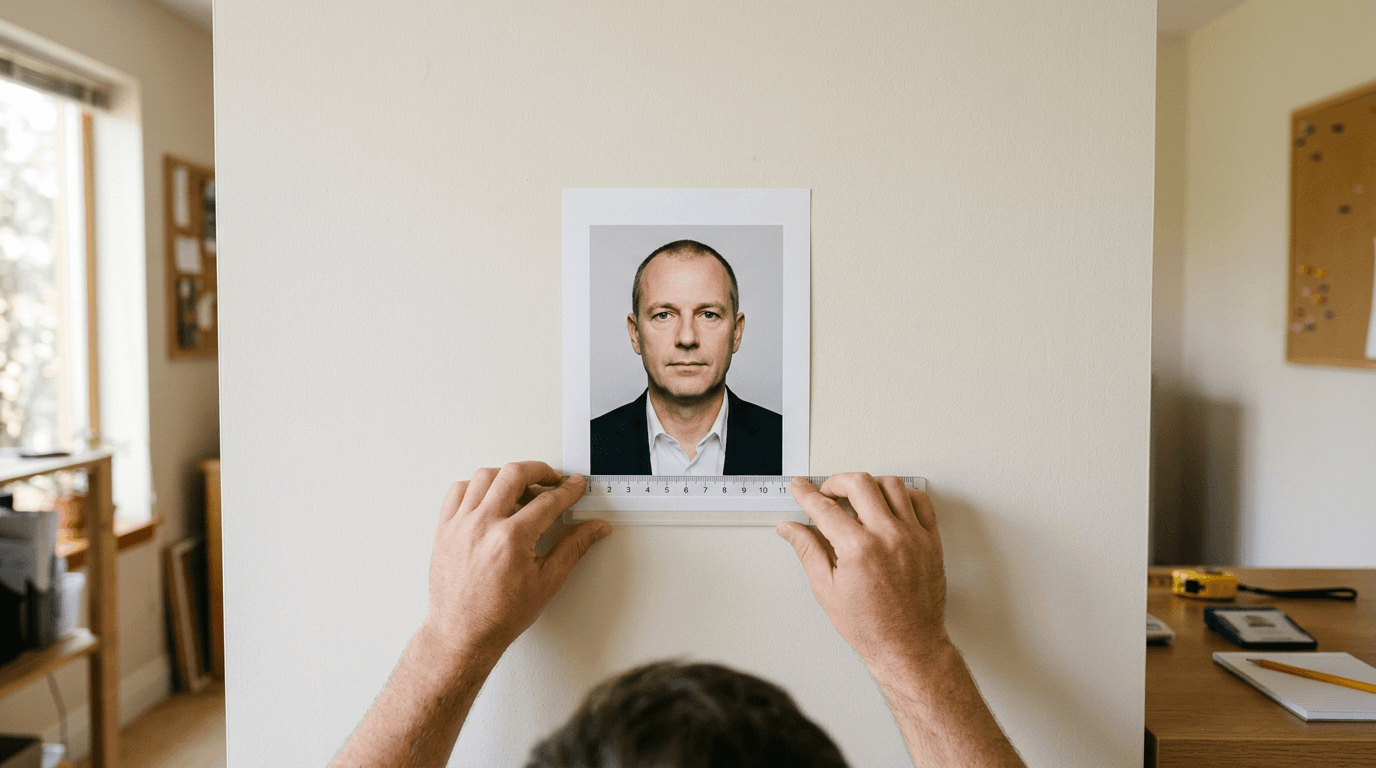
You are standing in a brightly lit high street pharmacy aisle, trying to keep an infant’s eyes open and face neutral while a machine counts down from three. Anyone who has applied for a travel document knows this specific tension. The technical standards for biometric identification are absolute, and a single shadow or a tilted chin will trigger an immediate rejection from HM Passport Office (HMPO). Navigating this strict compliance landscape requires choosing a passport photo service that matches both the applicant's ability to sit still and the submission format required by the government.
Quick Summary
A passport photo service provides compliant biometric images for official travel documents, either through physical studios, automated kiosks, or digital processing platforms. Choosing the right option depends heavily on whether you need a printed photograph or a digital ID code for online submission.
- In-Store Studios offer manual camera operation and immediate digital codes but require travel and higher fees.
- Self-Service Booths provide quick physical prints but lack the flexibility needed for infants or applicants with mobility constraints.
- Online Processors allow you to capture images at home using AI compliance checks, though you remain responsible for initial lighting.
- Selecting the correct fulfillment format mitigates the risk of application delays and repetitive costs.
Table of Contents
- Evaluating a passport photo service
- 1. Max Spielmann
- 2. Snappy Snaps
- 3. Photo-Me
- 4. PhotoAiD
- 5. Zippi
- 6. OddPrints
- Mapping environments to passport photo places
- Recommended Reads
| Service | Fulfillment Format | Features | Pros | Cons | Target Audience |
|---|---|---|---|---|---|
| Max Spielmann | In-Store Studio | Digital ID codes, manual capture, physical prints | Immediate code generation, staff assistance, in-store validation | Requires travel, higher retail pricing, stressful for infants | Applicants needing immediate digital codes and physical guidance |
| Snappy Snaps | In-Store Studio | Online ordering, digital codes, high street premises | Walk-in availability, digital ID provision, combined print options | Inconsistent franchise experiences, retail markups, travel required | High street shoppers wanting professional camera capture |
| Photo-Me | Self-Service Booth | Automated capture, ICAO compliance, immediate prints | Fast physical printing, widely available, no human interaction | Fixed seating heights, no infant support, low user ratings | Adult applicants renewing physical documents urgently |
| PhotoAiD | Online Processor | AI biometric checks, human verification, app access | Pre-flight compliance checks, home capture, double refund policy | Relies on user camera quality, requires decent home lighting, digital fee applies | Smartphone users wanting to capture images at home |
| Zippi | Online Processor | Photographic paper printing, home delivery, bulk prints | High-quality 270gsm paper, free standard delivery, eight prints provided | No biometric verification, shipping delays, express costs extra | Applicants with compliant digital files needing physical copies |
| OddPrints | Online Processor | Custom millimetre cropping, international shipping | Very low base cost, exact custom sizing, global delivery | Complete lack of compliance checks, requires user formatting, manual validation | Technical users comfortable formatting their own biometric dimensions |
Evaluating a passport photo service
Before comparing individual providers, you must isolate the actual bottleneck in your application process. The lens that genuinely separates these options is their Fulfillment Format. The mechanism by which the image is captured, validated, and delivered determines whether the service will succeed for your specific application type.
- In-Store Studio: A high street location where a human operator uses a digital camera and a pull-down background screen. The staff member visually validates the image against government rules, transfers the file to a secure terminal, and generates a digital code or prints the image. This format is built for adults who can follow instructions immediately, but often proves chaotic for infants who cannot.
- Self-Service Booth: An automated kiosk placed in a supermarket or post office. The applicant sits on a fixed stool, aligns their face with a digital overlay on a screen, and the machine captures and prints the image. These machines operate strictly on physical dimensions and cannot accommodate anyone who cannot sit unsupported.
- Online Processor: A digital platform where the user captures the image on a smartphone and uploads it. The software uses artificial intelligence to strip the background, align the biometric points (like eye height and head size), and format the file for digital submission or print delivery. This shifts the capture burden to the user but removes the time constraints of a retail environment.
1. Max Spielmann
Walk into a high street shop, and a staff member points a camera at you for a UK passport photo service. Operating primarily as an In-Store Studio, this provider relies on a vast network of high street shops and supermarket concessions to capture identification images, providing printed copies and a digital code.

The mechanism here is entirely physical and heavily reliant on the retail staff. You walk in, and an employee directs you to sit in front of a white or grey retractable screen. They use a standard digital single-lens reflex (DSLR) camera to take the photograph. The employee then ejects the memory card, inserts it into a proprietary retail terminal, and uses software to crop the image to the 35mm by 45mm UK standard. If you are applying online, the terminal uploads your image to a secure server and generates a unique digital ID code. When you enter this code into the HMPO website at home, the government system retrieves your photo directly from that server, bypassing the need for you to handle digital files entirely.
Physical premises dictate the processing speed
Relying on human staff creates delays with difficult subjects. The operator has a queue of retail customers waiting. Therefore, you have a narrow window of just a few minutes to achieve a compliant photograph. Consider the challenge of photographing a newborn. Strict government rules regarding open eyes and neutral expressions clash heavily with the pressure of a busy shop floor. I would hold off if you are managing a tired child. The retail environment severely limits the time you have to capture a compliant shot.
Buyers comparing options will note the £12.99 in-store price against the £10.00 self-service booth cost alongside the mixed 3.5 customer rating, pointing to an experience that varies sharply depending on how busy the specific shop is on the day you visit. The premium price tag pays for the physical real estate and the staff member's time, not necessarily a superior biometric outcome.
If your priority is walking away with a secure HMPO digital code in your hand without dealing with file uploads yourself, this retail approach secures that hand-off.
Pros
- Provides both a digital ID code and four physical prints in one session.
- Staff members visually assess the image for obvious compliance failures.
- Removes the technical burden of uploading files to the government portal.
Cons
- High retail pricing compared to digital alternatives.
- Time-pressured environment makes infant photography exceptionally difficult.
- Requires physical travel to a high street location during business hours.
2. Snappy Snaps
Unlike Max Spielmann’s centrally managed model, Snappy Snaps operates as a British photographic franchise offering professional in-store and online passport photo services across the UK. Functioning as an In-Store Studio, it leverages independent franchise owners operating under a unified brand to deliver biometric imaging alongside standard photo printing.
The core workflow mirrors traditional retail photography. In-store passport photo services include a digital ID code for online passport applications, generated by uploading the captured image from the shop's terminal to a compliant hosting server. When a customer opts for the digital route, they receive a physical receipt containing the alphanumeric code required by the government portal. Alternatively, online passport photo printing orders provide a set of six printed photos sized 45mm x 45mm. In this digital-to-physical workflow, the user uploads their own pre-captured image through the Snappy Snaps website, and the central laboratory prints and dispatches the physical copies.
Practical rule: Never assume a retail photo code guarantees HMPO acceptance; government software performs the final biometric scan, and retail staff can still miss subtle background shadows that trigger rejections.
Franchise structures introduce hardware variance
Because Snappy Snaps is a franchise, the equipment, lighting setup, and staff expertise vary significantly from one high street to the next. One branch might utilize a dedicated passport capture station with diffused studio lighting, while another might capture images near a shop window with mixed colour temperatures. Snappy Snaps holds an average TrustScore of 3.5 out of 5 stars on Trustpilot based on 585 reviews. This aggregate score reflects the inherent inconsistency of franchised operations, where the quality of the service is entirely dependent on the specific franchisee running that location.
The honest limit of this service lies in this unpredictability. You cannot guarantee the technical proficiency of the operator before you arrive, and you are paying premium retail rates for an outcome that relies on local execution. What would make me hesitate is the lack of standardized calibration across the network, meaning a shadow that passes one shop's visual check might still fail the government's automated software.
If you prefer dealing directly with an independent high street operator who can process your image while you wait, this franchise model offers that local presence.
Pros
- Walk-in service requires no prior booking or technical knowledge.
- Online printing option delivers six physical copies instead of the standard four.
- Local franchise owners often provide direct customer service.
Cons
- Lighting and camera equipment quality varies between franchise locations.
- Visual compliance checks are subjective and prone to human error.
- Physical store visits consume significantly more time than digital capture.
3. Photo-Me
Stepping away from human operators entirely, Photo-Me is a self-service biometric photo booth brand in the United Kingdom operated by the ME Group. Categorised strictly as a Self-Service Booth, these machines are deeply embedded in the UK's retail infrastructure, frequently positioned in supermarket lobbies and train stations to capture passing footfall.

The mechanism is heavily automated and physically rigid. You enter the booth, pull the curtain, and adjust a spinning stool to align your face with a digital oval on the screen. The machine relies on a fixed focal length camera and a harsh, automated flash burst to eliminate background shadows. The booths print a set of four UK ID photos approved by HMPO and compliant with ICAO (International Civil Aviation Organization) standards. The software evaluates the captured image internally, checking for face size, centring, and exposure before permitting the print to proceed.
Fixed machinery prevents applicant flexibility
Automation scales perfectly, but it cannot adapt to physical exceptions. The machine assumes the applicant can sit upright, unsupported, on a backless stool while looking directly into a lens at a fixed height. This structural reality immediately disqualifies infants, toddlers, and individuals with certain mobility restrictions. Furthermore, the user interface provides very little feedback if an image fails the internal check, leading to frustrating retakes. Photo-Me UK has a Trustpilot TrustScore of 1.5 out of 5 stars based on 30 reviews, heavily reflecting instances where machines malfunctioned, failed to print, or rejected applicants repeatedly without clear guidance.
I would bypass this option entirely if you are photographing anyone under the age of five, as the physical constraints of the booth make achieving a compliant, unsupported posture nearly impossible.
If you are an adult applicant who needs physical biometric prints in under three minutes while completing your weekly grocery shop, this automated infrastructure is unmatched for raw speed.
Pros
- Extremely rapid turnaround time for physical prints.
- Eliminates the need to interact with retail staff.
- Built-in software ensures basic ICAO metric compliance before printing.
Cons
- Fixed stool architecture cannot accommodate infants or small children.
- Harsh automated flash often results in washed-out complexions.
- Poor user reviews highlight frequent machine maintenance issues.
4. PhotoAiD
Moving the capture process into the home, PhotoAiD operates as an online biometric photography platform utilizing AI-driven image checks and human verification. As an Online Processor, it fundamentally changes the workflow by removing the physical camera operator and replacing them with algorithmic validation.
The mechanism operates directly on your own device. The software is compatible with web browsers as well as mobile apps for both iOS and Android devices. You take a photograph using your smartphone, ensuring the subject is looking at the lens. Once uploaded, the AI strips away whatever background is present (whether a living room wall or a garden fence) and replaces it with the exact flat white or grey required by the target country. It then maps the biometric points - measuring the distance between the eyes, the height of the crown, and the alignment of the chin - scaling the image to the exact millimetre requirements. The service charges £9.95 for a digital passport photo or £12.95 for printed copies with free delivery.
Algorithmic checks still depend on source lighting
Software can remove a background and scale a face, but it cannot fix bad lighting. If you take the photo with a strong window light on one side of the face, the resulting shadow across the nose will still cause an HMPO rejection. The AI cannot digitally relight a face without altering the biometric data, which is strictly prohibited. PhotoAiD offers a double money-back refund guarantee if a processed photo is rejected by HM Passport Office, and it holds a TrustScore of 4.5 out of 5 on Trustpilot based on 13,000 reviews. That guarantee mitigates the financial risk, but you still face the administrative delay of a rejected application if the source image was poorly lit.
When evaluating an online service, checking their protection against rejection helps limit financial risk, but it does not buy back the time lost to a failed application.
If you want the flexibility to take fifty photos of a moving toddler at home until you get one with their eyes open, this dual-layered verification system provides the necessary technical safety net.
Pros
- Allows unlimited capture attempts in a comfortable home environment.
- AI automatically removes non-compliant backgrounds and scales the image.
- Backed by a double money-back guarantee against government rejection.
Cons
- Users must manage their own ambient lighting to avoid facial shadows.
- The £9.95 digital fee is high for a purely software-based transaction.
- Printed copies introduce postal delays to the application timeline.
5. Zippi
Zippi approaches the market from the fulfillment side, operating as a UK-based online printing service that creates and ships passport-sized prints directly to users' homes. Sitting in the Online Processor category, it does not attempt to capture the image; it exists solely to turn your existing digital file into a compliant physical object.
The core mechanism is industrial print fulfillment. A set of eight regulation size UK passport photos costs £9.99 with free delivery included. The user uploads a digital file that they believe is already compliant. Zippi processes this file through commercial photo lab equipment, ensuring the passport photos are printed on 270gsm photographic paper. This paper weight is critical, as HMPO explicitly rejects images printed on standard desktop printer paper due to durability and scanning issues. Once printed, the sheet is dispatched through the postal system. Express UK delivery without a signature is available for £1.49.
Physical shipping delays digital application timelines
This service relies entirely on the user getting the biometric formatting right before the upload. Zippi acts as a dumb pipe; it prints what you send. If the head size in your digital file is 25mm instead of the required 29mm to 34mm, Zippi will print it flawlessly on heavy paper, and the passport office will reject it. Zippi holds an average TrustScore of 4.5 out of 5 stars on Trustpilot based on 67 reviews, indicating strong print quality, but it assumes technical competence from the buyer. I would steer clear of this route if you have not already run your image through a biometric compliance checker, as the cost of printing a non-compliant file is entirely yours to bear.
If you have already secured a perfectly cropped biometric image and simply lack the high-grade photographic paper required for a postal application, this service bridges that physical gap.
Pros
- Delivers eight physical copies, double the standard retail offering.
- Utilizes correct 270gsm photographic paper to meet HMPO print standards.
- Free standard delivery keeps the base price competitive.
Cons
- Provides zero biometric compliance checking or background removal.
- Standard postal delivery delays the physical application process.
- Express shipping adds an extra fee to the final transaction.
6. OddPrints
Operating at the most granular technical level, OddPrints is an online custom photo cropping and resizing service delivering passport and wallet-sized prints. As an Online Processor, it strips away the guided experience in favour of absolute dimensional control.
The mechanism is a web-based cropping tool. Users upload a photograph and manually drag a digital bounding box to set the exact physical dimensions they want printed. The service offers custom photo sizing for passport and wallet prints starting from £0.69. Because it is not locked to UK standards, it is heavily used by expatriates needing obscure visa sizes. The platform delivers custom prints to the United Kingdom, United States, Canada, and Australia, and provides free standard shipping on orders over £20.
Practical rule: Never scale an ID photograph visually; always use the specific millimetre measurements published by the destination country's embassy to ensure the head size falls within the legal boundaries.
Manual sizing shifts compliance responsibility to the user
The extreme low cost comes from the total absence of automated intelligence. OddPrints does not know if you are printing a passport photo or a picture for a locket. It will not warn you if the background is too dark, if the subject is smiling, or if the file resolution is too low for physical printing. You are essentially renting access to a precise digital guillotine and a commercial printer. The honest limit here is the steep learning curve: if you do not know the exact millimetre requirements for an infant's Schengen visa, this tool will not teach you.
Before relying on manual cropping tools, familiarising yourself with UK and international photo guides ensures you are inputting the correct dimensional data.
If you are a technically proficient user applying for a foreign visa with non-standard dimensional requirements, this platform provides the exact control you need for pennies.
Pros
- Base printing cost is exceptionally low at £0.69.
- Allows exact millimetre cropping for non-standard international visas.
- International shipping supports applications submitted from abroad.
Cons
- Forces the user to manage all biometric compliance manually.
- Minimum spend of £20 required to unlock free shipping.
- Interface requires understanding of physical aspect ratios and resolution.
Mapping environments to passport photo places
Selecting the right passport photo price and format is rarely about finding the absolute cheapest option; it is about matching the fulfillment mechanism to the applicant's reality.
If you are submitting an application for a newborn or a toddler, an Online Processor removes the greatest variable: time. By capturing the image at home, you can wait for the child to be alert, lay them on a plain sheet, and take as many attempts as necessary. The AI handles the technical formatting, allowing parents to focus entirely on the child's expression. Attempting to force an infant into a retail schedule frequently results in rejected images and repeated trips.
When a digital application portal requires an immediate, secure ID code and you are an adult applicant who can follow directions, an In-Store Studio is highly effective. The premium paid over digital services covers the immediate generation of the HMPO code and the visual check provided by the staff. It outsources the technical burden entirely to the retailer.
For adults renewing a driving licence or a physical passport on a strict deadline, a Self-Service Booth remains the fastest route to physical paper. If your posture allows you to use the fixed machinery, these kiosks bypass queues and human interaction entirely, delivering compliant 270gsm prints in under three minutes.