8 Essential Facts About EU Passport Size Photo Requirements for 2026
Navigating international travel documentation requires precise attention to detail, particularly regarding identity imagery. Whether you are applying for a residence permit, a travel document, or a visa, adhering to the specific eu passport size photo standards is mandatory to avoid application delays. While there is a common framework across many European nations, nuances in background colour, lighting, and biometric positioning can vary significantly between borders.

Quick Summary
European passport and visa image standards typically follow the International Civil Aviation Organization (ICAO) guidelines, requiring a 35mm by 45mm frame. Applicants must ensure a neutral expression, direct eye contact, and a plain, light-coloured background to meet biometric security requirements across member states and the Schengen Area.
- Uniform size: 35mm x 45mm is standard in most EU countries.
- Biometric compliance: Neutral expressions and open eyes are mandatory.
- Lighting: Uniform, shadow-free illumination is essential for identification.
- Background: Plain white, off-white, or light grey is generally required.
Table of Contents
- 1. Standard European Dimensions
- 2. Passport Photo Size Germany
- 3. Passport Photo Size Spain
- 4. Ireland Passport Photo Size
- 5. Italian Passport Photo Size
- 6. The Importance of Biometric Integrity
- 7. Common Causes for Rejection
- 8. Digital vs Print Standards
- FAQ
- Recommended Reads
1. Standard European Dimensions
Most nations within the European Union adhere to the 35mm wide by 45mm high format. This consistency is largely driven by the adoption of ICAO Doc 9303, which sets the global standard for machine-readable travel documents. Within this frame, the head size generally must occupy 70 to 80 per cent of the vertical space.
Understanding these dimensions is critical because automated scanning systems use facial recognition to verify identity. If the head is too large, too small, or offset from the centre, the software may flag the image as non-compliant. This UK & International Baby Passport Photo Requirements & Guides resource provides a deeper look into how these measurements function across different regions.
2. Passport Photo Size Germany
Germany follows the strict 'Biometrietauglich' (biometric-capable) standard. The passport photo size Germany requires is the standard 35mm x 45mm. However, the Federal Printing Office is particularly rigorous regarding the 'frontal' requirement; even a slight turn of the head or a non-neutral expression can result in a rejection at the Bürgeramt.
This level of strictness ensures that the image is compatible with the electronic storage chip embedded in German passports. It is recommended that applicants avoid wearing glasses if possible, as reflections on the lenses are a frequent cause of technical failure during the biometric verification process.
3. Passport Photo Size Spain
For those applying for Spanish documentation, the passport photo size Spain mandates is also the 35mm x 45mm format. The focus here is on the contrast between the subject and the background. Spanish authorities typically require a plain white background without any shadows or patterns that could interfere with facial recognition algorithms.
Because the Spanish administrative process is highly digitised, the file quality must be high. High-resolution source images are necessary to ensure that when the photo is cropped to the required dimensions, the facial features remain sharp and clearly identifiable by the processing software.
4. Ireland Passport Photo Size
Ireland maintains a specific set of guidelines that align with its online application system. While the printed Ireland passport photo size is 35mm x 45mm, the online submission process requires a high-resolution digital file. The Irish system is noted for its user-friendly digital upload tool, which provides immediate feedback on whether the photo meets the necessary criteria.
Applicants should ensure their hair does not obscure their face, and they must maintain a closed mouth. Even with the shift towards digital applications, the underlying physical requirements for lighting and head position remain as stringent as they would be for a physical printed copy.
5. Italian Passport Photo Size
In Italy, the passport photo size Italian passport photo size is 35mm x 45mm, but there is a distinct emphasis on the quality of paper and print if submitting a physical application. The Italian Questura requires images to be printed on high-quality photographic paper with a matte finish, as glossy paper can cause glare during scanning.
This attention to material choice is part of a broader commitment to ensuring the document's longevity and security. When capturing an image, one must ensure that the light source is balanced equally on both sides of the face to avoid shadows under the chin or nose, which are often cited as reasons for refusal in Italian consulates.
6. The Importance of Biometric Integrity
Biometric integrity refers to the accuracy with which a photograph represents the applicant's unique facial features. Technologies such as facial mapping rely on distance measurements between the eyes, nose, and mouth. Any distortion, such as the use of a wide-angle lens, can compromise this data.
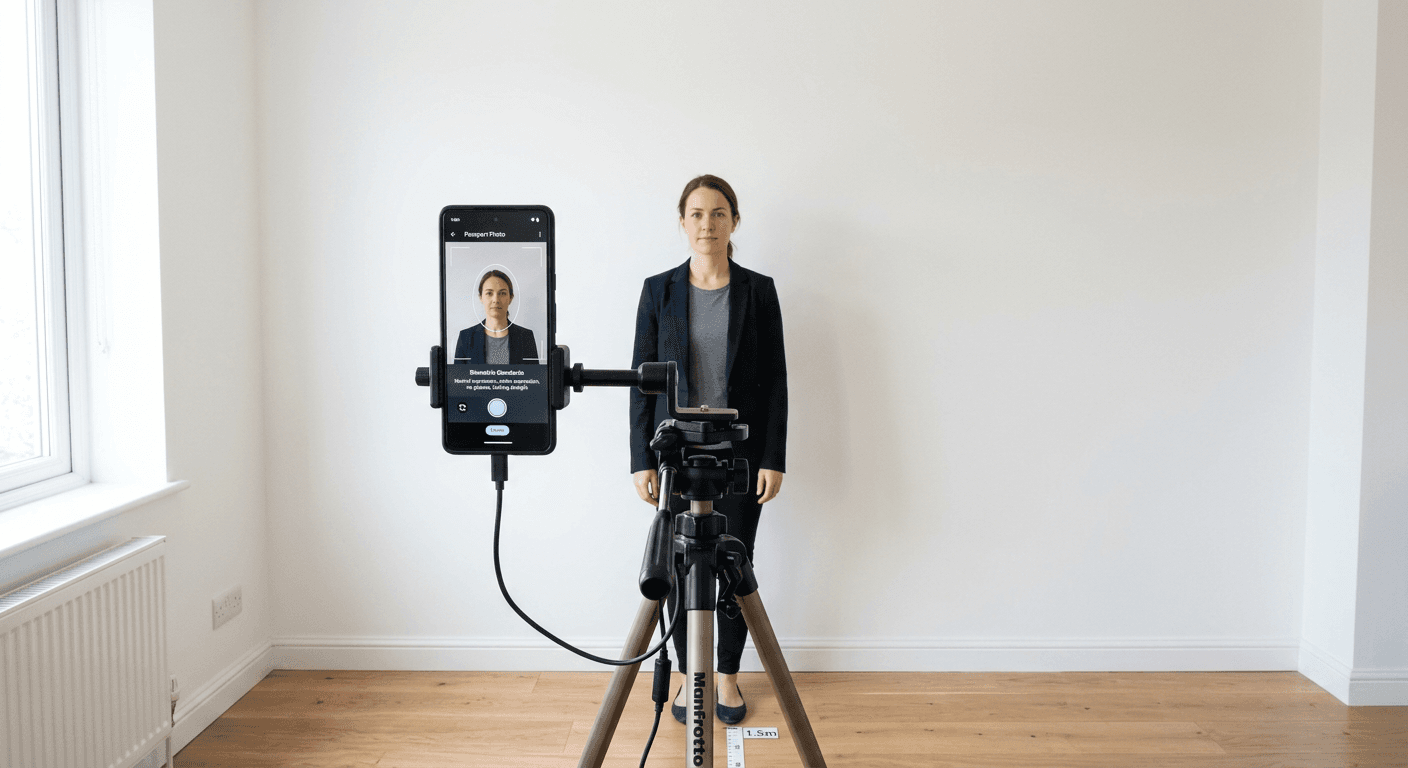
Maintaining the correct european passport photo size is only the first step. The subject must maintain a natural, neutral expression with both eyes clearly visible. Using a standard camera lens from a distance of at least 1.5 metres helps prevent the 'fish-eye' effect that often occurs when taking photos with modern smartphone cameras at close range.
7. Common Causes for Rejection
Even when dimensions are correct, photos are frequently rejected due to poor environmental control. Common issues include shadows falling on the background, uneven lighting that casts a shadow on one side of the face, and 'red-eye' caused by flash photography.
Another significant issue is clothing; hats, head coverings (unless for religious reasons), and high-contrast patterned shirts can distract the automated systems. It is best practice to wear solid, dark-coloured clothing against the required light-coloured background to ensure the system can clearly identify the edges of the shoulders and head.
8. Digital vs Print Standards
While the physical dimensions remain 35mm x 45mm, digital submission requirements often include a minimum pixel density - typically 600dpi. It is essential to ensure that the image file is saved in a widely compatible format such as JPEG or PNG, as proprietary file formats may not be readable by all government portals.
When printing for home use, one should avoid scaling the image to fit the paper. Instead, use a template that preserves the original aspect ratio and resolution. Failure to maintain these standards can result in the image being stretched or pixelated, both of which are grounds for rejection by passport control offices.
FAQ
Do all European countries use the same passport photo size? Most countries in the European Union and the Schengen Area use the 35mm by 45mm format, but you should always check the specific requirements of the issuing authority for your nationality as local variations may apply.
Can I wear glasses in my passport photo? While some countries allow glasses if they are necessary for vision, it is highly discouraged due to the risk of glare or lens reflections. If you must wear them, ensure there is no reflection obscuring your eyes.
What background colour is required for a European passport photo? In most cases, a plain, light-coloured or white background is required. This ensures the necessary contrast for facial recognition systems to detect your features accurately.
Why is my passport photo rejected if it looks fine to me? Rejections are often based on technical criteria invisible to the naked eye, such as incorrect head-to-chin ratios, inadequate pixel density, or shadow presence. Always follow the specific technical guidelines provided by the passport office.