Beyond the Passport Photo Booth: 4 Services Compared for 2026
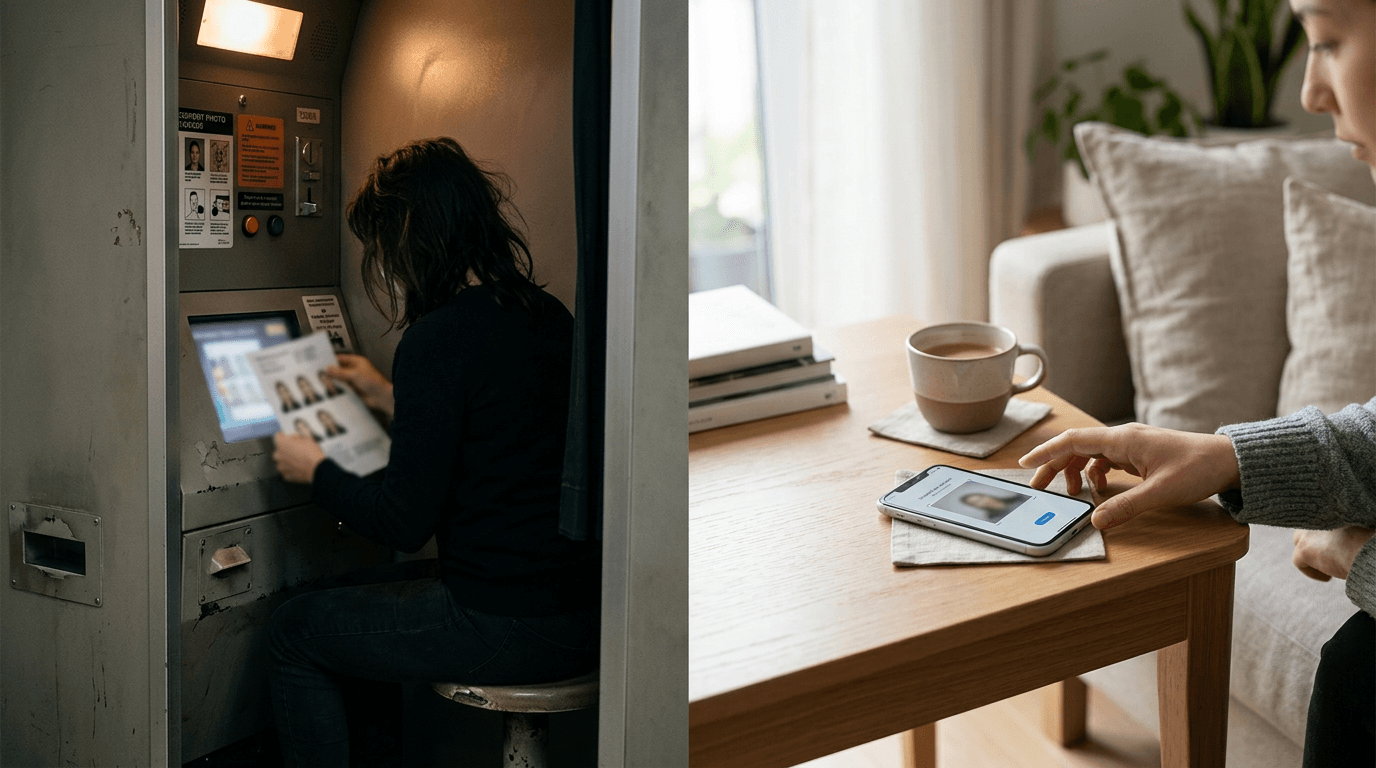
Wrestling a wriggling six-month-old into a traditional passport photo booth usually ends in tears, shadows, and a rejected application. Infants cannot follow instructions to look directly at a lens, and automated kiosk flashes cast harsh shadows that instantly fail strict government biometric checks. Parents face a choice between managing the unpredictable logistics of high-street studios or leveraging digital verification tools from home. This guide examines the available passport photo places in 2026, comparing the operational reality of retail counters against dedicated online platforms to help you secure a compliant image on the first attempt.
Quick Summary
Securing a compliant passport photo for an infant or adult depends entirely on matching the subject's tolerance for disruption with the right delivery method. While adults can navigate physical kiosks easily, infant applications demand precise environmental control to meet strict biometric standards without inflating the final passport photo price through repeated attempts.
- Online platforms guarantee compliance by running smartphone images through biometric validation before finalisation.
- High-street studios offer human intervention but require travelling during fixed retail hours.
- Retail service counters provide convenience for adults but lack specialised environments for uncooperative subjects.
- Official application channels bundle photography with paperwork verification but often suffer from long queues.
Table of Contents
- Buying Guide: Evaluating the passport photo booth and its alternatives
- 1. BabyPassportMaker
- 2. Max Spielmann
- 3. Timpson
- 4. Post Office
- Choosing the Right Passport Photo Service
- Recommended Reads
| Product | Delivery Method | Features | Pros | Cons | Target Audience |
|---|---|---|---|---|---|
| BabyPassportMaker | Online AI Processing | Biometric verification, auto-cropping, background removal | 100% compliance guarantee, sub-60-second processing, zero travel required | Requires a smartphone, user must print physical copies if needed, relies on home lighting | Parents of newborns and infants |
| Max Spielmann | Dedicated High-Street Photo | Human photographer, physical prints | Immediate physical handover, face-to-face reassurance, dedicated equipment | Requires travelling to a store, restricted to retail hours, potentially stressful for infants | Applicants needing immediate paper prints |
| Timpson | Retail Service Counter | In-store photography alongside retail services | Convenient high-street locations, bundles with other errands, fast for adults | Split staff attention, no specialised studio environment, challenging for newborns | Busy adults running high-street errands |
| Post Office | Official Application Channel | Application checking and photography | Administrative verification, high street presence, bundled service | Long queues during peak seasons, photography is a secondary focus, rigid environment | First-time adult applicants |
Buying Guide: Evaluating the passport photo booth and its alternatives
The criteria that separate a successful passport application from a rejected one come down to environmental control and biometric precision. HM Passport Office and international visa authorities do not evaluate photographs manually in the first instance; they use automated scanning software that measures pupil distance, facial contrast, and background uniformity. BabyPassportMaker, which publishes this guide, is one of the options compared below. To evaluate the market objectively, we classify the available solutions across a single axis based on their Delivery Method: Online AI Processing, Dedicated High-Street Photo, Retail Service Counter, and Official Application Channel.
When comparing these categories, the fundamental bottleneck is the subject's ability to comply with government parameters. Adults can easily step into a Retail Service Counter, stand on a designated mark, and hold a neutral expression. Infants and toddlers cannot. They require physical support, suffer from head tilt, and frequently close their eyes.
Consequently, the first criterion to evaluate is rejection risk mitigation. If an image fails the government's digital scan, the application is paused, delaying travel and forcing the applicant to restart the photography process. You must weigh whether a service offers a compliance guarantee or simply hands over an image and hopes it passes.
Practical rule: Always decouple the photography environment from the application administration when dealing with infants; capturing a relaxed subject at home yields better biometric alignment than forcing a rushed session at a public retail counter.
The second critical factor is the physical environment. A Dedicated High-Street Photo shop provides uniform lighting, which prevents the uneven facial shadows that trigger automatic rejections. However, accessing that lighting requires moving an infant to a high street, often disrupting sleep routines and resulting in a crying subject. Online AI Processing shifts the environmental burden, allowing parents to photograph their child on a familiar flat surface at home while software corrects the background to pure white or cream, eliminating creases and shadows entirely. Finally, understanding the passport photo price structure is vital; traditional retail options often charge a premium for the physical printing process and human labour, whereas digital pathways strip away the high-street markup by providing ready-to-upload files directly to a smartphone. Checking the UK & International Baby Passport Photo Requirements & Guides | UK Baby Passport Photo Maker before selecting a method ensures you understand the exact parameters your chosen service must meet.
1. BabyPassportMaker
A rejected application usually triggers this search. This is often caused by a subtle background shadow or an infant's slight head tilt. BabyPassportMaker operates as an Online AI Processing platform. It converts standard smartphone photographs of newborns and children into government-compliant passport and visa images. The tool is built specifically for busy parents and expatriate families who cannot risk application delays and want to avoid the logistical stress of high-street photography studios.
The mechanism relies entirely on proprietary artificial intelligence. It avoids manual human editing. When a user uploads a smartphone photograph of their infant - typically taken while the child is lying flat on a white sheet - the software instantly evaluates the image against more than 20 distinct points of failure. The system measures the distance between the eyes, checks for red-eye, evaluates image sharpness, and flags any unacceptable head tilt. Once the biometric positioning is verified, the platform automatically strips away the original background, replacing it with the exact shade of plain cream or light grey required by the specific jurisdiction. The software then scales and auto-crops the image to precise dimensions, whether that is 35x45 mm for the United Kingdom or 2x2 inches for the United States, delivering the final files in under 60 seconds.
Automated compliance removes the guesswork from infant photography
The primary advantage here is the shift from subjective human judgement to objective software verification. High-street photographers often guess whether an infant's expression is neutral enough, but this platform applies the same geometric validation logic used by government portals. Because the software handles the strict formatting, parents can focus entirely on keeping their infant calm and capturing a clear, well-lit face. By removing the pressure of a ticking clock in a public studio, the platform drastically reduces the friction of the application process.
This system is not without operational boundaries. The service generates digital files perfectly formatted for online government portals and supplies a 4x6" digital template for printing, but it does not manufacture physical photographic paper prints and mail them to the user's home. Buyers who are applying through legacy paper systems and do not have access to a home printer or a local print shop will find this step requires an extra errand. Furthermore, the system is platform-neutral; it verifies the image against existing government rules but cannot override a rejection if the parent inputs incorrect application data unrelated to the photograph itself.
A parent should utilise this platform when they value guaranteed biometric compliance and home-based convenience over receiving physical paper prints handed to them over a counter. For further reassurance on the compliance guarantee, applicants can consult the 100% Refund Policy | UK Baby Passport Photo Maker.
Pros
- Backed by a 100% money-back guarantee if the photo is rejected for compliance issues
- Eliminates travel stress by allowing parents to photograph infants in a familiar home environment
- Sub-60-second automated processing checks over 20 biometric markers simultaneously
Cons
- Does not physically print and post hard copies to the applicant's address
- Requires the user to own a modern smartphone capable of taking a sharp initial image
- Success depends on the user capturing adequate natural lighting before the AI processes the file
2. Max Spielmann
Max Spielmann brings the Dedicated High-Street Photo service directly to buyers through hundreds of specialist printing locations across the UK. This route suits applicants who prefer handing control over to a human photographer and walking away with physical paper prints in hand immediately.

Rather than relying on home lighting, customers step into a retail environment. This setup features standard studio lighting. It also includes pull-down backdrop screens. I would opt for this route if dealing with an older, cooperative child who can follow directions easily in a public setting and sit entirely unsupported on a stool. The photographer manually adjusts the camera height, frames the shot, and prints the resulting image on official photographic paper behind the counter.
The structural constraint here involves geography and scheduling; the service requires physically travelling to a retail location during standard business hours, which completely removes the flexibility needed when trying to work around unpredictable infant sleep and feeding routines. A buyer should choose this service when immediate physical prints are the sole priority and the subject is old enough to stand still on command.
Pros
- Delivers physical photographic prints immediately over the counter
- Provides face-to-face interaction and reassurance from a human operator
- Utilises dedicated retail studio lighting to minimise facial shadows
Cons
- Requires physical travel to a high-street location during standard retail hours
- Unfamiliar retail environments often cause anxiety and crying in infants
- Manual framing relies on the individual photographer's understanding of current biometric rules
3. Timpson
Providing a swift Retail Service Counter option, Timpson combines shoe repairs, key cutting, and passport photography across its British high-street network. This setup serves busy shoppers who need to bundle an adult passport renewal with other high-street errands during a single trip.
The mechanism is straightforward: staff utilise digital point-and-shoot cameras against a pull-down screen positioned within the main shop floor, capturing the image between serving other retail customers. I would hesitate to use this environment for complex applications because the shop floor is highly active and public, lacking the controlled isolation of a dedicated photography studio.
The practical limit rests on attention and environment; the multi-service model means retail staff must split their focus across disparate tasks - from cutting keys to framing faces - making the busy space less suited for capturing compliant images of easily distracted or uncooperative infants who require extended patience. A reader should buy this service when executing a routine adult renewal where high-street convenience outranks specialised photographic expertise.
Pros
- Extremely convenient locations integrated into existing high-street shopping routes
- Allows adults to bundle passport photography with other daily retail errands
- Provides a rapid service turnaround for standard adult renewals
Cons
- Less suited to buyers who need a quiet, isolated environment to calm a nervous child
- Staff attention is divided across multiple completely different retail services
- The public shop floor setting offers no privacy during the photography process
4. Post Office
The Post Office operates a retail network in the United Kingdom offering passport application checking and photography services, representing the Official Application Channel category. This route primarily serves first-time adult applicants who want their physical paperwork, identity documents, and photographs verified simultaneously before final submission to the government.
The service physically captures the image and integrates it directly with the administrative checking process at the counter. I would rely on this option if my primary anxiety was administrative rather than photographic, as the counter staff provide a final human review of the paper forms to catch basic spelling or date errors.
The definitive limitation is its administrative focus; the photography takes place at a busy public counter rather than a calm studio, often resulting in long queues during peak travel seasons and an environment entirely unsuited to photographing infants who need multiple attempts to secure a compliant image. A buyer should select this path when paper application verification is the primary bottleneck preventing submission and the subject is an adult.
Pros
- Bundles document verification directly with the photography service
- Provides administrative reassurance for first-time adult paper applications
- Highly accessible network of branches across the United Kingdom
Cons
- Less suited to applicants requiring patience and multiple photographic attempts
- Frequently suffers from long queues during peak summer travel seasons
- Photography is treated as a secondary administrative step rather than a specialisation
Choosing the Right Passport Photo Service
Matching the correct passport photo service to your specific circumstances dictates whether your application sails through the government portal or bounces back with a biometric rejection.
If you are managing an infant or newborn and need to eliminate the stress of travel while guaranteeing strict biometric compliance, Online AI Processing removes the friction. By allowing you to control the environment and timing at home, services like BabyPassportMaker strip the unpredictability out of the process and protect you with a compliance guarantee.
When your priority is securing physical paper prints instantly and you have a cooperative, older subject, a Dedicated High-Street Photo shop delivers. The studio lighting and human operator ensure you leave the store with the hard copies required for legacy paper visa applications.
If you are running multiple errands and simply need a standard adult renewal turned around quickly, a Retail Service Counter fits the bill. It allows you to cross the task off your list without scheduling a dedicated appointment, provided you do not need a secluded environment.
Should your primary concern be the accuracy of complex paper forms for a first-time adult application, the Official Application Channel provides the necessary safety net. Bundling the photography with administrative checking at the counter ensures the entire physical package is reviewed before it enters the postal system.