Correct Sizing for Global Passport Photos
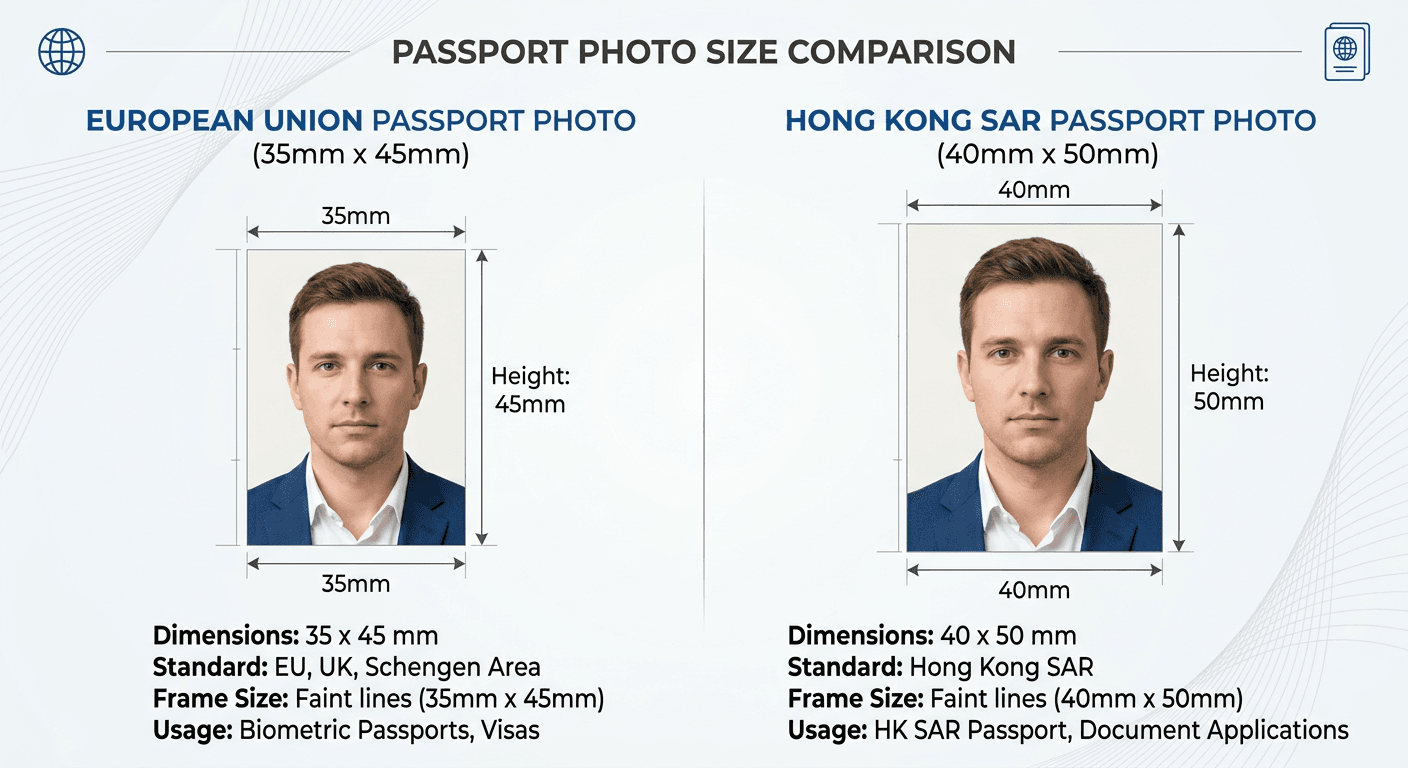
Ensuring your identity documentation complies with international standards is vital for seamless travel, as failure to provide a correct passport photo size often leads to application rejection. Whether you are navigating the specific requirements for a Malaysia passport photo size or preparing documentation for a European holiday, precision is the difference between a processed application and a significant delay.
Quick Summary
Passport photo sizing is a strictly regulated process where dimensions, background colour, and facial proportions must align with the issuing country's requirements. These standards ensure biometric systems can accurately verify identities. To avoid rejection, verify the exact pixel or millimetre requirements of the specific nation, as global standards are not uniform.
- Dimensions vary by country; always verify the current national specifications.
- Backgrounds must generally be plain, neutral, and free of shadows or patterns.
- Facial expressions must be neutral with eyes clearly visible.
- Proper lighting and head positioning are critical for successful biometric scanning.
Table of Contents
- Quick Summary
- Understanding Global Passport Photo Standards
- Navigating Malaysia Passport Photo Size Requirements
- European Requirements: Italian and Spanish Standards
- Meeting Hong Kong Passport Photo Size Guidelines
- Comparison of International Passport Specifications
- Common Pitfalls in Digital Passport Photography
- Frequently Asked Questions
- Recommended Reads

Understanding Global Passport Photo Standards
International passport photography adheres to standards set by the International Civil Aviation Organisation (ICAO), which dictates facial size, position, and lighting to facilitate machine-readable travel documents. While these are baseline recommendations, sovereign nations often implement additional criteria regarding colour depth, specific cropping, and background requirements that vary significantly.
Digital compliance is increasingly complex due to biometric scanning requirements. Authorities require high-resolution images that prevent pixelation, as sub-par digital files can distort facial features. Before you begin the process, it is useful to review the passport photograph guide to understand the technical parameters required for government submission.
Navigating Malaysia Passport Photo Size Requirements
When applying for documentation in Malaysia, the standard Malaysia passport photo size must be exactly 35mm wide by 50mm high. Unlike many other nations that favour the square 35mm x 45mm format, Malaysia enforces a specific verticality that can catch travellers off guard if they are relying on generic automated software.
Beyond the physical dimensions, the photo must feature a white background with no shadows. The applicant must be dressed in dark-coloured clothing to ensure a clear contrast against the white backdrop. For those unsure about specific documentation policies, reviewing the terms of service provides insight into how professional software handles these non-standard aspect ratios.
European Requirements: Italian and Spanish Standards
European nations generally align closely with one another, yet discrepancies persist. The Italy passport photo size, which is identical to the typical Italian passport photo size requirements, sits at the standard 35mm x 45mm. This dimension is the gold standard for Schengen area documentation, ensuring consistency across member states.
Similarly, the Spanish passport photo size also adheres to the 35mm x 45mm specification. However, the nuance in these countries often lies in the 'head-to-frame' ratio. Authorities typically require the head to occupy 70-80% of the image height. If you are struggling to get these proportions right, contacting the support team can clarify how to adjust your crop settings to meet these specific continental regulations.
Meeting Hong Kong Passport Photo Size Guidelines
The Hong Kong passport photo size is defined as 40mm wide by 50mm high. This is one of the most distinct sizing requirements, diverging from the European norm. Because of the larger width compared to standard 35mm photos, it is critical that the subject is perfectly centred to avoid edge cropping during the final printing phase.
This specific dimension is designed to fit the unique layout of Hong Kong's biometric passport pages. Applicants must ensure that the head is neither too close to the top edge nor too small in the centre of the frame. Providing a photograph that fails to meet this specific ratio will almost certainly result in the rejection of the application at the processing office.
Comparison of International Passport Specifications
| Country | Required Dimensions (mm) | Background Colour |
|---|---|---|
| Malaysia | 35 x 50 | White |
| Italy | 35 x 45 | White or Light Grey |
| Spain | 35 x 45 | White |
| Hong Kong | 40 x 50 | White |
Pro Tip: Always take your photos in a well-lit area without direct sunlight, as high-contrast shadows across the face are the primary reason for automated system rejection in European and Asian passport systems.
Common Pitfalls in Digital Passport Photography
One of the most frequent mistakes users make involves improper file compression. Even if the dimensions are correct, a low-quality, compressed image will fail to meet the DPI (dots per inch) requirements often cited by immigration departments. Always save your image in an uncompressed format if possible, such as a high-quality JPEG.
Additionally, facial expression is paramount. A neutral expression with a closed mouth is universally required. Wearing glasses, while sometimes permitted, is increasingly discouraged as reflections on the lenses can obscure the eyes, leading to an automatic failure during the verification stage of your application process.
Frequently Asked Questions
- Can I use the same photo for a Hong Kong and an Italian passport? No. Because the Hong Kong passport photo size is 40mm x 50mm and the Italian requirement is 35mm x 45mm, they are not interchangeable.
- Does the background need to be strictly white? While many countries accept light grey or off-white, a plain white background is the safest choice to ensure compliance across all international borders.
- What is the most common reason for photo rejection? Shadows on the face or background, incorrect head size ratios, and poor lighting are the top three reasons for rejection.
- Should I wear glasses in my passport photo? It is strongly advised to remove glasses to avoid lens glare, which frequently causes issues with biometric facial recognition software.