Decoding Global Passport Size Photo Measurements to Prevent Application Rejections
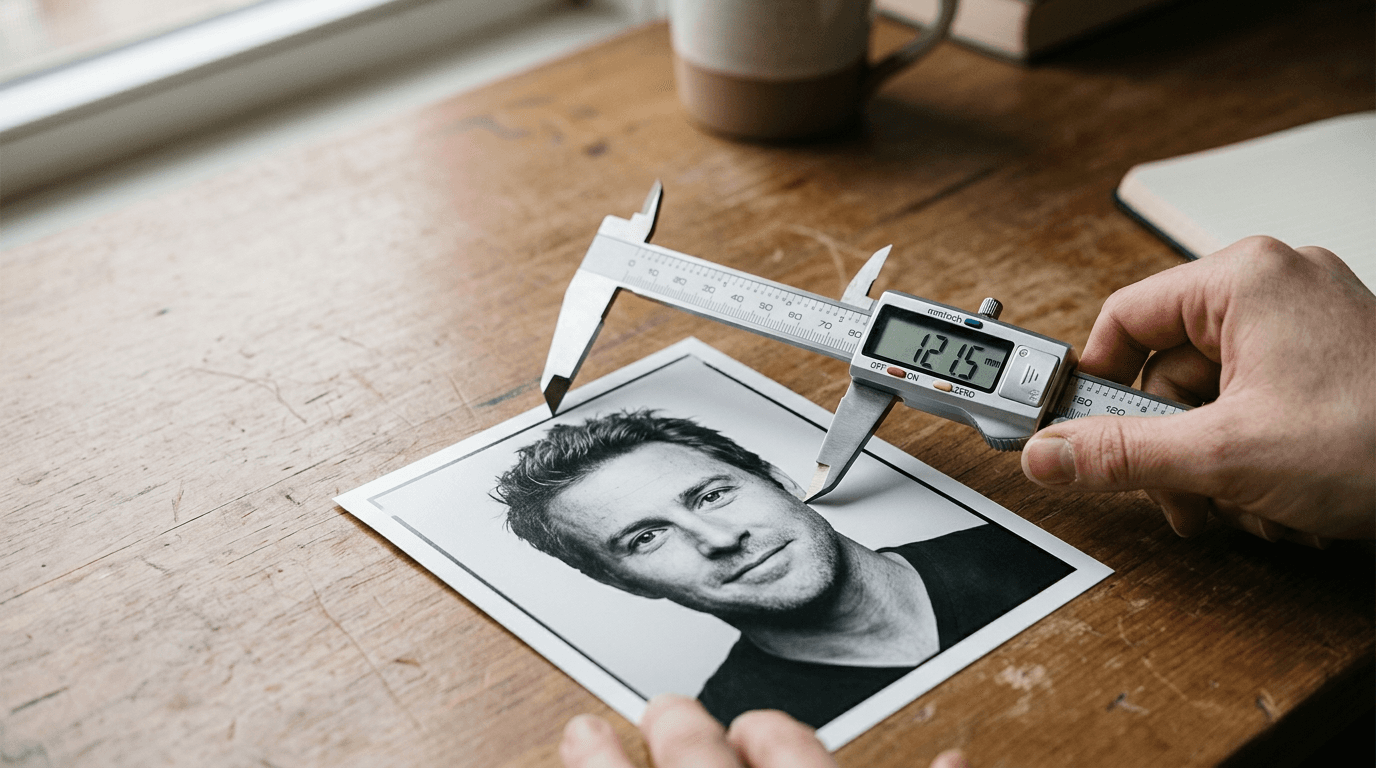
Picture the moment at the post office: you present a physically flawless print, trimmed exactly to the edges by a professional studio, only for the clerk to measure the distance from the subject's chin to the crown of their head and reject it for being three millimetres too short. A valid passport size photo is never simply about the outer paper boundary. It acts as a strict biometric container. Border control algorithms do not scan the edges of the paper; they scan the geometric relationships between the eyes, nose, and mouth. When the scale is wrong, the file is unreadable.
Quick Summary
A compliant identification image requires exact outer dimensions paired with strict internal biometric scaling to pass automated border control systems. Authorities reject applications when the subject's head occupies the wrong percentage of the frame, regardless of how perfectly the paper is cut.
- The United Kingdom, Europe, and Australia mandate a 35x45 millimetre physical print.
- The United States and India enforce a 51x51 millimetre square format.
- Internal measurements are strictly enforced, requiring the head to fill 70 to 80 percent of the vertical space.
- Digital submissions rely on exact pixel densities rather than physical rulers.
Table of Contents
- Why the outer cut is only half the requirement
- The 35x45 millimetre standard dictates European and UK applications
- When the 2x2 inch format governs the Americas and India
- Digital submissions demand distinct file properties
- Where infant scaling breaks adult measurement rules
- Visual comparison of global formatting standards
- FAQ
- Recommended Reads
Why the outer cut is only half the requirement
Automated border gates operate by mapping the facial topography of the person standing in front of them against the data stored on the microchip inside the travel document. For the initial application to succeed, the facial recognition software used by the issuing authority must be able to extract that topography from the submitted image. This requires the eyes, nose, and mouth to sit at specific vertical and horizontal coordinates within the rectangle. The software calculates the distance between the pupils, the width of the nose, and the exact position of the jawline relative to the edges of the frame.
If a physical print measures perfectly along its outer borders, but the camera was positioned too far away, the head will appear too small within that frame. The algorithm will search for the eyes in the upper third of the image and find blank space. This is the primary mechanism behind compliance rejections. Authorities define a strict bounding box - an invisible rectangle within the visible photograph - where the subject's face must sit. When the scale is wrong, the facial features fall outside these designated coordinates, and the file is rendered mathematically unreadable.
Failing to meet these internal proportions renders the physical crop entirely irrelevant. Before submitting any application, verifying the exact internal proportions against the issuing authority's Terms & Conditions is essential for avoiding administrative delays. The measurement from the bottom of the chin to the top of the skull must always fall within a strictly specified millimetre range. This establishes the correct biometric scale before the outer edges are even considered. Relying purely on the physical cut of the paper without verifying the internal head height guarantees a rejection at the processing centre.
The 35x45 millimetre standard dictates European and UK applications
The dominant global specification, codified under the ISO/IEC 19794-5 standard, dictates a physical print measuring 35 millimetres wide by 45 millimetres tall. This rectangular orientation is the legal requirement across the United Kingdom, the European Union, Australia, and New Zealand. The vertical bias of this rectangle is designed to capture the full length of the head and the immediate top of the shoulders, omitting the wider torso entirely. The frame must remain tightly focused on the biometric markers without introducing unnecessary background data.

The internal mathematics of this standard are unforgiving. HM Passport Office dictates that the distance from the very bottom of the chin to the crown of the head must measure exactly between 29 and 34 millimetres. The crown is defined strictly as the top of the skull, entirely ignoring any additional height added by voluminous hair. Calculating the precise passport size photo dimensions required for approval means ensuring this exact ratio is maintained. If the head measures 36 millimetres tall, the image is rejected for being too close. If it measures 28 millimetres, it is rejected for being too far away.
Practical rule: Always measure the distance from the bottom of the chin to the top of the skull, pressing the ruler against the physical photograph and explicitly excluding hair volume, before checking the outer crop.
Furthermore, the positioning must leave appropriate negative space. The standard demands a vertical gap of approximately 3 to 5 millimetres between the top of the hair and the upper edge of the photograph. Reviewing comprehensive UK & International Baby Passport Photo Requirements & Guides reveals that failing to leave this negative space prevents the alignment software from properly anchoring the image, resulting in a failed scan.
When the 2x2 inch format governs the Americas and India
While the rectangular standard dominates Europe, the United States, India, and several other nations enforce a square format measuring 51 by 51 millimetres. Generating a compliant 2x2 passport photo requires an entirely different approach to composition. Because the frame is significantly wider relative to its height, the camera captures far more of the subject's shoulders and chest than the European standard permits. This alters the optical centre of the photograph, pushing the face slightly higher in the visual frame.
This change in aspect ratio forces a change in the internal bounding box. The US State Department requires the subject's head to measure between 1 inch and 1 3/8 inches (between 25 and 35 millimetres) from the bottom of the chin to the top of the head. Additionally, the subject's eyes must sit specifically between 1 1/8 inches and 1 3/8 inches (28 to 35 millimetres) from the bottom edge of the physical photograph. A failure on either measurement results in an immediate rejection letter.
A common failure mode occurs when applicants applying for foreign visas attempt to convert a European rectangular image into an American square image by simply adding blank white borders to the sides of a 35x45 print. This alters the internal biometric scaling. The facial proportions remain locked in the European vertical format, rendering the head too large for the 51x51 bounding box. A photograph must be shot and composed specifically for the square aspect ratio; it cannot be safely retrofitted from a narrower frame.
Digital submissions demand distinct file properties
Physical prints represent a declining fraction of modern applications. Government portals now predominantly process digital files, requiring an entirely different set of technical specifications. A digital upload enforces passport size photo measurements through pixel density and file architecture rather than a physical ruler. A perfectly composed photograph will still fail if the underlying file format is incorrect.
For a UK digital application, the image file must be at least 600 pixels wide and 750 pixels tall. This exact 4:5 ratio accurately mimics the physical 35x45 millimetre print. The United States demands a minimum of 600 by 600 pixels to maintain its square ratio, capping the maximum allowable resolution at 1200 by 1200 pixels. Submitting a file with massive resolution, such as a raw 12-megapixel smartphone image, often causes automated portal rejections because the file exceeds the maximum permitted weight, usually strictly capped around 10 megabytes.
Conversely, aggressive file compression entirely ruins the biometric read. Sending an image through a messaging app like WhatsApp strips the EXIF data and introduces lossy compression artefacts - microscopic blurring and pixelation around the fine edges of the eyes and mouth. When the government's algorithm attempts to measure the facial landmarks, these blurred pixels create a false reading, leading to an immediate digital failure.
Practical rule: Transfer digital application files via email or cloud storage using original, uncompressed settings to preserve the exact pixel boundaries required by facial recognition software.
If an applicant encounters repeated digital rejections despite the visual appearance seeming correct, consulting a technical Help Center can help identify whether an incorrect sRGB colour profile or hidden compression artefact is the root cause of the system failure.
Where infant scaling breaks adult measurement rules
Applying strict adult biometric geometry to infants creates an immediate structural conflict. Newborns possess entirely different head-to-body proportions and lack the cervical strength to hold their heads entirely upright. When an infant is laid flat on a white sheet for a photograph, gravity compresses the shoulders against the surface and tucks the chin downward, distorting the vertical plane the algorithm typically expects to measure. Furthermore, the camera angle required to shoot downwards introduces slight lens distortion.
Issuing authorities recognize this biological reality and apply specific leniency rules. For children under one year of age in the UK, the eyes do not need to be fully open, and the strict 29-millimetre minimum chin-to-crown measurement is often treated with slight flexibility if attempting to achieve it would mean artificially cropping the image. However, the outer dimensions of the file or print must remain entirely exact. The leniency applies only to the internal anatomy, never the external container or the pixel boundaries.
A frequent mistake parents make is artificially zooming in on an infant's face to forcefully hit the 29-millimetre mark. Because an infant's head is proportionately wider than an adult's, zooming in too far crops out the jawline and ears. The entire head must remain visible within the frame. Automating this delicate balance through a dedicated UK Baby Passport Photo Maker ensures the extraction and background replacement happen without digitally stretching or distorting the child's natural facial proportions.
Visual comparison of global formatting standards
Understanding the strict distinction between regional requirements prevents the mistake of submitting a technically flawless print to the wrong jurisdiction. The table below outlines the primary differences in physical and digital formats required by major issuing authorities.
| Region / Authority | External Dimensions | Internal Chin-to-Crown | Digital Pixel Minimum |
|---|---|---|---|
| UK & Europe (HMPO/EU) | 35 x 45 mm | 29 - 34 mm | 600 x 750 pixels |
| United States (State Dept) | 51 x 51 mm | 25 - 35 mm | 600 x 600 pixels |
| Australia (DFAT) | 35 x 45 mm | 32 - 36 mm | High resolution scans only |
| India (Ministry of Ext. Affairs) | 51 x 51 mm | 25 - 35 mm | 350 x 350 pixels |
The background colour also strictly diverges by region. While the UK demands a light grey or cream background to provide contrast against the skin without washing out the subject, the United States mandates pure white. Submitting a European grey background to an American processing facility results in automatic disqualification, regardless of how perfectly the external measurements are met.
FAQ
What happens if my physical print is one millimetre too large?
The processing clerk or scanning machine will reject it immediately. The designated cutout templates used by passport offices are rigid. If a print is 36 by 46 millimetres, it will not fit inside the physical scanning frame, preventing the digital capture from occurring.
Can I cut down a 2x2 inch print to fit a 35x45 millimetre application?
No. Trimming the sides off a square photograph fundamentally alters the internal proportions. By the time you remove 16 millimetres of width to reach the 35-millimetre requirement, you will likely cut into the subject's ears or cheeks, destroying the necessary biometric data.
Do baby passport photos require the exact same head measurements as adults?
No. While the outer paper dimensions must match the adult standard exactly, authorities provide leniency on the internal chin-to-crown measurements for infants under one year old, recognising their different anatomical proportions and inability to hold their heads up.
Why is my digital photo rejected when the printed dimensions were correct?
Digital rejections usually stem from file compression, incorrect aspect ratios, or strict resolution limits. A physical image scanned at too low a resolution creates pixelated edges around the eyes and mouth, causing the facial recognition algorithm to fail its scan.