German passport photo requirements: How to pass EU biometric checks
An application submitted to the Bundesdruckerei (German Federal Printing Office) relies entirely on a machine's ability to map facial geometry before a human ever looks at the file. Meeting German passport photo requirements is a matter of satisfying software algorithms that measure the exact millimeter distance between the pupils and the bottom of the chin. If these ratios fall outside the strict International Civil Aviation Organization (ICAO) tolerances, the application is rejected automatically. The margins for error are exceptionally tight, particularly when capturing images of infants and young children who cannot follow posing instructions.
Quick Summary
European biometric passport standards demand precise geometric alignment, specific contrast ratios, and strict dimensional tolerances to function with automated border control systems. Failing to meet these specifications results in immediate application rejection.
- The mandatory passport photo size Germany requires is 35x45mm.
- The face must occupy 70 to 80 percent of the total image height.
- Backgrounds must be uniform, neutral grey, and entirely free of shadows.
- Software algorithms map the distance between eyes, nose, and chin for biometric verification.
- Automated tools can correct background contrast but cannot fix an obscured jawline or tilted head.
Table of Contents
- Why biometric scanners reject minor shadows
- What the EU standard actually measures
- Where infant applications fail most often
- How background contrast determines validity
- When to process the image yourself
- FAQ
- Recommended Reads
Why biometric scanners reject minor shadows
Biometric identification relies on nodal points. When an image is scanned by European border control systems, the software maps the peaks and valleys of the face to create a mathematical formula. Shadows cast across the cheeks or under the nose alter the perceived depth of these facial features, effectively changing the mathematical model the scanner generates. If a shadow obscures the exact boundary of the chin, the software cannot calculate the total facial height, triggering an immediate rejection.
This mechanism is why the Germany passport photo requirements explicitly forbid uneven lighting. The light source must be diffuse and hit the face directly from the front. Directional lighting creates a gradient across the face, causing one side to appear darker than the other. While a human processor can easily identify the subject despite this gradient, biometric software interprets the darker side as having different physical dimensions.
For applicants processing these images at home, avoiding shadows requires specific environmental setups. Facing a large window on an overcast day provides the necessary flat, diffuse light. Relying on overhead room lighting invariably casts harsh shadows beneath the eyebrows and chin, which alters the biometric map. Those needing to review the specific international baby passport photo requirements should ensure their lighting setup provides entirely even illumination across both sides of the face.
What the EU standard actually measures
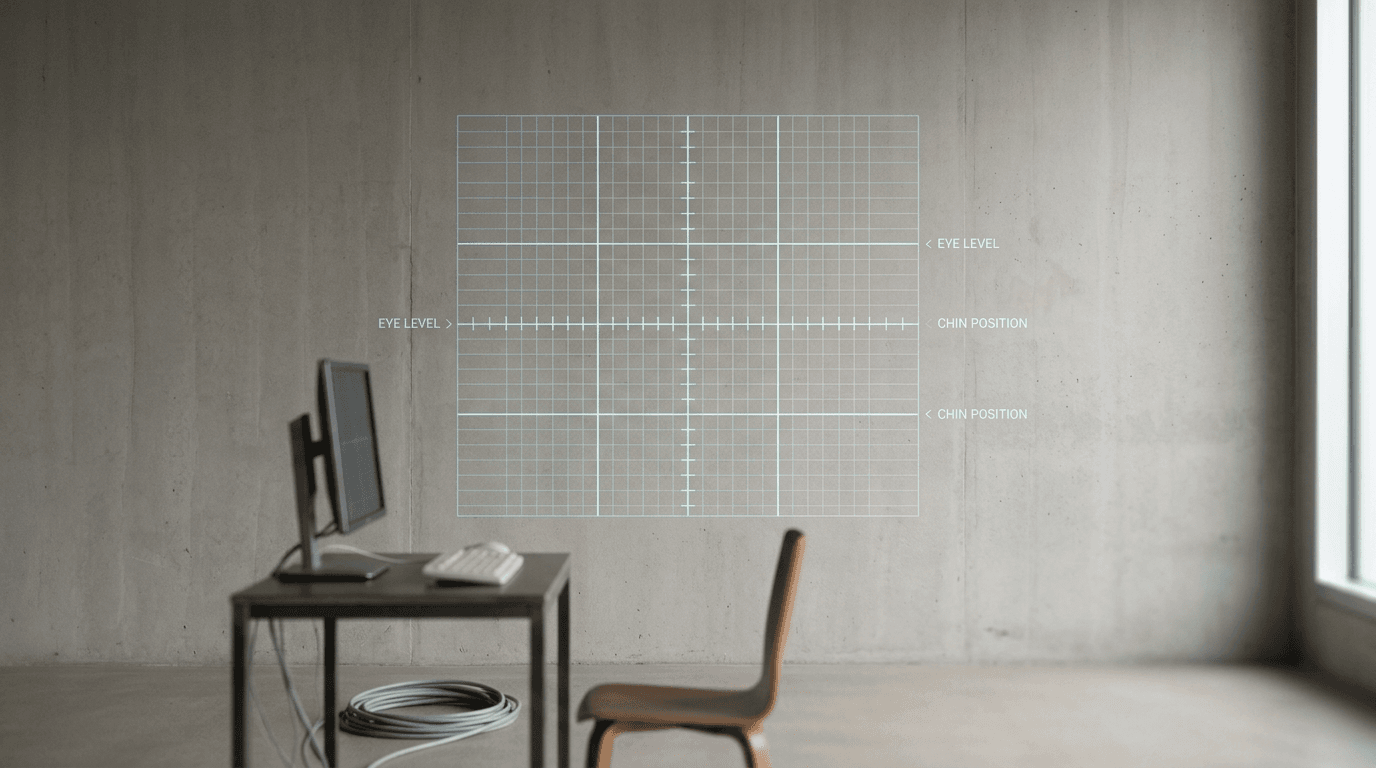
The core of the biometric standard is the facial ratio within the frame. The passport photo size Germany dictates is strictly 35mm in width and 45mm in height. However, the external dimensions are only the canvas; the critical measurements occur within that space. The distance from the bottom of the chin to the crown of the head must measure between 32mm and 36mm. This ensures the face occupies between 70 and 80 percent of the total image height.
If the face is too small, the scanner lacks sufficient pixel density to map the nodal points accurately. If the face is too large, the software cannot identify the outer boundaries of the head or the surrounding background, which it uses as a calibration reference. Furthermore, the vertical position of the eyes is tightly regulated. The horizontal line connecting the pupils must sit between 20mm and 30mm from the bottom edge of the photograph.
| Specification Dimension | EU/Germany Standard | UK Standard | US Standard |
|---|---|---|---|
| Overall Size | 35x45 mm | 35x45 mm | 51x51 mm (2x2 inches) |
| Face Height | 32-36 mm | 29-34 mm | 25-35 mm |
| Background Colour | Light Grey | Light Grey / Cream | Plain White or Off-White |
| Expression | Neutral, mouth closed | Neutral, mouth closed | Neutral, mouth closed |
Practical rule: Measure the face height from the lowest point of the chin to the top of the skull, ignoring hair volume. If the hair extends beyond the frame but the skull sits within the 32-36mm zone, the image is compliant.
Where infant applications fail most often
Applying these rigid biometric standards to infants introduces severe practical difficulties. A newborn cannot support their own head or respond to directional commands, yet the biometric algorithm applies the same geometric tests to an infant as it does to an adult. When evaluating an EU passport size photo for a child, rejections typically stem from three distinct failures that look similar to the untrained eye but require different corrections.
First, off-centre gaze occurs when the child looks slightly past the camera lens rather than directly into it. The software measures the visible area of the sclera (the white of the eye) on both sides of the iris. If the measurements are asymmetric, the system determines the head is turned, even if the nose appears centered. The fix requires positioning the lens exactly at the child's eye level and using a visual trigger located directly on the camera body.
Second, obscured chin lines happen when a baby rests their chin on their chest, a common posture for infants lacking neck strength. This hides the lower boundary of the face, making it impossible for the software to calculate the total facial height. The solution involves laying the infant flat on their back, which naturally extends the neck and exposes the jawline.
Third, foreign objects in the frame frequently ruin otherwise perfect shots. A parent's supporting hand, a visible pacifier, or a bulky collar all interfere with the background isolation algorithm. The software must be able to clearly distinguish the outline of the head and shoulders from the space behind them. If you run into recurring issues with subject isolation, reviewing the Help Center documentation on common posing errors can identify the specific obstruction causing the failure.
How background contrast determines validity
The background of a biometric photo serves a distinct mechanical purpose: it provides a high-contrast reference point that allows the software to define the exact edges of the subject. A European passport photo size image requires a uniform, neutral grey background. This differs significantly from the pure white background mandated by US standards, and the distinction is entirely functional.

Pure white backgrounds often cause light to bounce back into the camera lens, creating a phenomenon known as blooming, where the edges of lighter-coloured hair or pale skin blend into the background. A mid-tone grey background prevents this light bounce, ensuring a sharp, high-contrast edge around the entire silhouette. If the software cannot find a continuous, unbroken line separating the subject from the background, it assumes the image is either overexposed or poorly cropped.
Shadows on the background itself are equally problematic. Even if the face is perfectly lit, a drop shadow cast onto the background behind the subject introduces an irregular shape that the algorithm cannot identify. The software may interpret the shadow as an extension of the hair or clothing, throwing off the centering calculations.
Practical rule: Position the subject at least half a metre away from the background wall. This distance prevents the subject's body from casting hard shadows onto the surface behind them.
If the original image contains a perfect biometric facial capture but fails the background contrast test, digital manipulation of the background is the only viable salvage method. Automated systems exist specifically to isolate the subject and replace uneven backgrounds with the precise digital grey tone required by European authorities. Those attempting this digital replacement should ensure the software correctly maps fine details like wisps of hair, as hard, jagged cut-outs are easily flagged as manipulated images by human inspectors.
When to process the image yourself
The traditional route of visiting a photography studio offers the benefit of professional lighting equipment, but it introduces severe stress when capturing infants. Studios charge for the time and the physical print, and a screaming infant rarely produces a compliant neutral expression within a ten-minute appointment window. Processing the image yourself shifts the focus from capturing a perfect photo in one take to capturing a perfect expression over time, and handling the technical requirements later.
Modern automated tools handle the geometric cropping and background isolation automatically. A parent can take fifty photos of a child lying on a grey blanket at home, select the single frame where the child's eyes are open and mouth is closed, and feed that file into a dedicated UK baby passport photo maker platform. The software then applies the 35x45mm crop, measures the 32-36mm face height, and smooths the background to the required grey tolerance.
However, DIY processing is not suitable if the original capture is fundamentally flawed. Software cannot digitally open a child's eyes, close their mouth, or rotate a turned head without triggering anti-forgery flags in border control systems. If the biometric data is missing from the original file, no amount of cropping will create compliance. You should only rely on automated processing when you possess a sharply focused, evenly lit base image where the subject is looking directly at the lens. For understanding exactly how these automated systems handle data processing and user privacy during the conversion, consulting a detailed Privacy Policy provides clarity on how biometric templates are temporarily stored and scrubbed.
FAQ
Can a baby's mouth be slightly open in a German passport photo?
No. While some countries offer leniency for infants under one year, German authorities strictly enforce the neutral expression rule. The mouth must be entirely closed, and no teeth or tongue may be visible.
What is the exact passport photo size Germany requires?
The final physical print must measure exactly 35 millimetres in width and 45 millimetres in height, with the face taking up 32 to 36 millimetres of that vertical space.
Can I wear glasses in a European passport photo?
Technically yes, provided the frames do not obscure any part of the eyes and there is absolutely no glare on the lenses. However, due to the high rejection rate caused by minor reflections, it is strongly advised to remove all glasses before capturing the image.
Why was my photo rejected for 'low contrast'?
Low contrast means the software could not distinguish the boundary between your facial features or between your head and the background. This is usually caused by flat lighting, overexposure, or wearing clothing that exactly matches the background colour.
Are digital passport photos acceptable for German applications?
If applying online or through an approved digital portal, an exact digital file meeting the pixel equivalent of the 35x45mm ratio is required. Physical applications still require printed photos on high-quality photographic paper.