Navigating Italian Passport Photo Requirements and Spain Visa Photo Size Rules
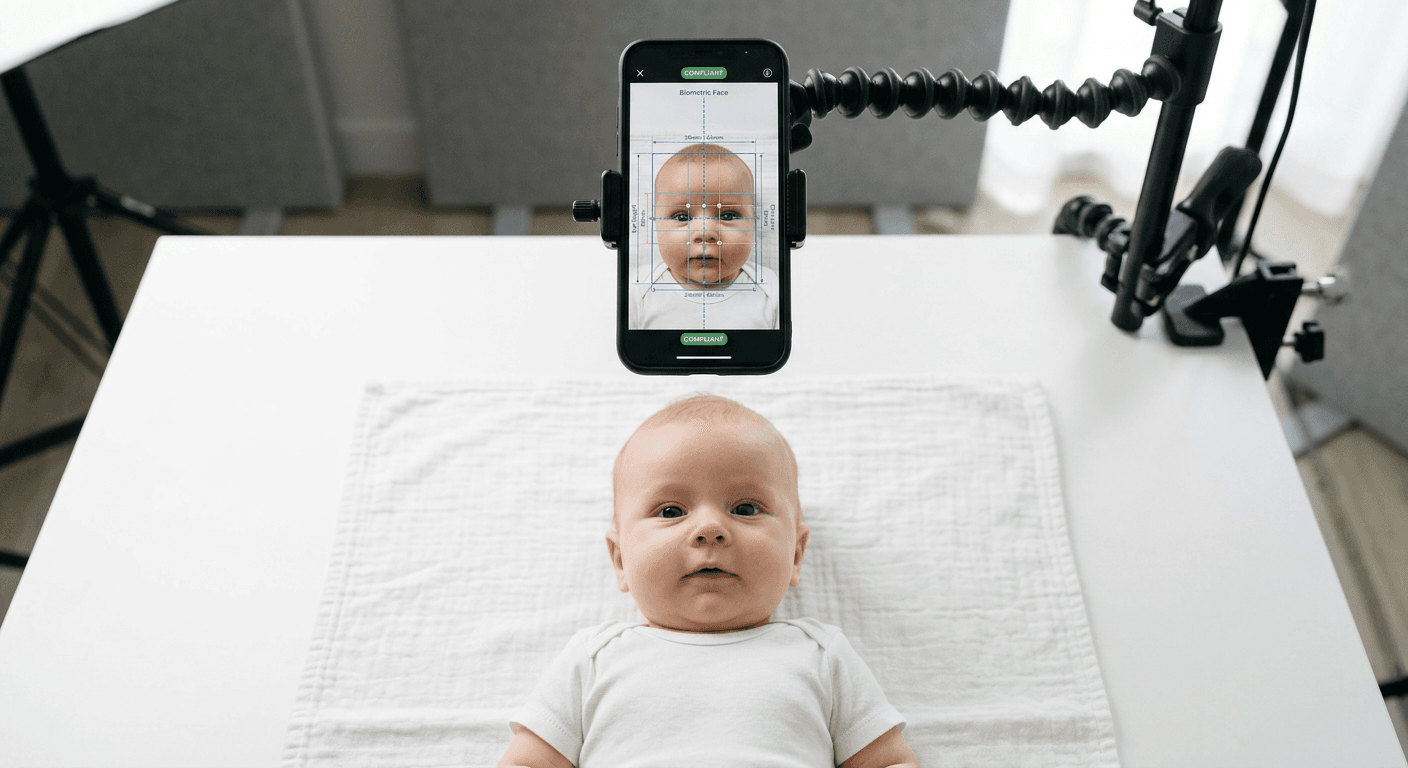
Laying a restless newborn onto a white sheet, hoping to capture a perfectly neutral expression, only to have a consulate reject the physical print three weeks later because the head-to-chin ratio is off by two millimetres - this is the reality of documenting an infant for international travel. Navigating italian passport photo requirements is a mechanical exercise in geometry, not photography. While the European Union shares a general biometric framework under the International Civil Aviation Organization (ICAO), individual national consulates enforce their own specific tolerances and dimensions when processing infant applications. Assuming a standard local chemist's print will pass muster in Rome or Madrid is the most common reason for delayed dual citizenship applications and missed travel dates. Knowing exactly how these governments measure, scan, and audit biometric images prevents weeks of administrative friction.
Quick Summary
Biometric passport and visa photographs for Italian and Spanish authorities demand exact dimensional, postural, and background adherence to international standards, with strict algorithmic checks that frequently fail homemade infant images.
- Italian passports require a specific 35x40mm physical dimension, breaking from standard European formats.
- Spanish visa applications demand precise facial coverage dominating the vertical space on a standard 35x45mm template.
- Shadows, visible parental hands, or improper lens focal lengths guarantee automatic rejection.
- Digital auditing against official algorithms prevents weeks of consulate processing delays.
Table of Contents
- Why italian passport photo requirements trigger biometric failures
- Where dimensional specifications differ fundamentally
- The mechanics of background masking and focal contrast
- Why infant posture breaks facial geometry
- How to audit a digital file before submission
- Comparison Table: Biometric Specifications
- FAQ
- Recommended Reads
Why italian passport photo requirements trigger biometric failures
When a physical print arrives at an Italian or Spanish consulate, it is not simply looked at by an official; it is scanned directly into a biometric recognition system. These systems run software that does not see a child's face in human terms. Instead, it generates a T-zone map consisting of the interpupillary distance (the exact pixel count between the centres of the eyes), the vertical alignment of the nose bridge, and the fixed anchor point of the chin.
If an infant cannot independently support their head, their chin drops slightly toward their chest. This slumping mechanically alters the measurable vertical distance between the chin and the crown of the head. When the distance compresses, it immediately breaks the geometric map the software relies on, resulting in an automated failure.
Furthermore, the algorithms are programmed to assess background contrast by looking for continuous, hard edges around the perimeter of the skull. Fine infant hair blending into a poorly lit or off-white background causes the software to misinterpret the shape of the head entirely. The scanner calculates the edge of the hair as the boundary of the background, mapping a misshapen skull that fails the symmetry check.
Many parents assume that if a photograph looks clear and focused to the human eye, it will suffice. However, consulates reject images for digital noise, incorrect colour temperature, and microscopic lens distortions that shift facial proportions. Relying on a generic smartphone snap or a standard retail booth ignores the mathematical rigidity of the processing software used at the government level.
Where dimensional specifications differ fundamentally
European nations adhere to the broader ICAO biometric guidelines, but the exact physical cropping of the photograph varies based on the physical card or visa sticker the host country issues. Submitting the wrong dimensions guarantees rejection before the photograph even reaches the biometric scanner.
Mapping the italy passport photo size against standard norms
The standard biometric photograph in the UK and much of the Schengen area measures 35x45 millimetres. However, the precise italy passport photo size mandated by the Ministry of Foreign Affairs is strictly 35x40 millimetres.
This five-millimetre reduction in height drastically alters how the subject must be framed. Because the face must still occupy the vast majority of the vertical space to meet strict chin-to-crown measurement criteria, there is virtually no margin for error above the head or below the chin. If you supply a standard 35x45mm photograph, the consular clerk must manually trim the image to fit the 35x40mm physical scanner tray. If the original face was too large in the frame, this manual trimming will inevitably slice off the top of the child's head or crop the chin out of bounds, resulting in an instant geometric failure.
Defining the spain visa photo size and consulate tolerances
Conversely, the spain visa photo size aligns with the more common 35x45 millimetre standard used across the Schengen zone. However, Spanish consulates are exceptionally stringent regarding the background purity and facial coverage percentages.
For a Spanish visa application, the head must also measure precisely 32 to 36 millimetres from the bottom of the chin to the top of the head (excluding hair). Spanish authorities allow minor leniency for newborns regarding a completely closed mouth - acknowledging that infants under six months often breathe through their mouths or struggle to hold a neutral expression - but they offer zero tolerance for closed eyes or subjects looking away from the camera barrel. The eyes must sit vertically between 20 and 30 millimetres from the bottom edge of the physical print, a metric the consulate will measure with a physical template before scanning.
The mechanics of background masking and focal contrast
Photographing a child against a pure white or light grey background sounds straightforward, but camera sensor mechanics heavily complicate the outcome. When you place a baby on a flat white cotton sheet, the overhead ambient lighting casts distinct drop shadows beneath the neck, under the jawline, and around the ears.
Biometric scanners interpret a dark shadow as a physical extension of the face, throwing off the left-to-right symmetry calculations entirely. If you attempt to digitally erase these shadows using a basic smartphone editing tool, the software often leaves a jagged halo of pixels around the fine hair. Consular software flags this artificial masking as image tampering, returning an automatic rejection for digital manipulation.
Practical rule: To eliminate drop shadows when photographing an infant from above, place a tightly rolled towel beneath the white sheet directly under the baby's neck to elevate the head slightly, separating the subject from the background plane and allowing ambient room light to fill the gaps.
Colour temperature is the second hidden failure mode. Modern smartphones automatically adjust white balance based on the dominant light source in the room. If you photograph a baby in a bedroom lit by warm LED bulbs, the pristine white sheet will render as a muddy yellow or orange on the sensor. A dedicated UK baby passport photo maker platform bypasses this failure by algorithmically neutralising the background entirely, replacing the yellow-tinted fabric with a mathematically pure white pixel matrix that explicitly passes consulate contrast checks without triggering tampering flags.
Why infant posture breaks facial geometry
The primary obstacle in capturing infant documentation is supporting the subject without introducing foreign objects into the frame. The "hidden hand" problem occurs when a parent attempts to hold the baby's head steady from behind. Even if the fingers are successfully obscured behind the head, the physical pressure distorts the child's ears or stretches the skin around the jawline, resulting in a failed symmetry check. If a finger is visible - even blurred in the background - the photograph is instantly voided.
Furthermore, the focal length of the camera fundamentally changes the biometric shape of the face. Smartphone cameras default to wide-angle lenses (typically a 24mm or 26mm equivalent). If you hold the phone twenty centimetres from the baby's face to fill the frame, the wide-angle optical distortion drastically inflates the size of the nose and forehead while receding the ears and narrowing the chin. This creates a "fisheye" effect that completely ruins the biometric T-zone map.
Practical rule: Never hold a camera closer than 1.2 metres to the subject; instead, stand well back to flatten the optical distortion and rely on cropping the high-resolution image later to achieve the required 70-80% facial coverage.
Shooting from an angle rather than perfectly parallel to the child's face introduces a similar vertical distortion. If the camera looks slightly down at the infant, the forehead stretches, causing the biometric map to miscalculate the vital distance between the eyes and the chin.
How to audit a digital file before submission
Before paying for physical prints or booking an expensive consulate appointment, the digital file must be audited against the specific country's algorithmic rules. Relying on a manual ruler held against a computer screen cannot account for digital artefacts, exact pixel density, or contrast ratios.
First, verify the file resolution. Both Italy and Spain require a minimum of 600 dots per inch (DPI) for physical prints. Compressing the image by sending it through a messaging app like WhatsApp strips the metadata and introduces JPEG artefacting around the eyes and hairline. The biometric scanner reads these compression artefacts as image noise and rejects the file. Always transfer the original file via email or a direct cloud drive link to preserve the pixel density.
Second, check the 20-point facial map. The image must have entirely even lighting across both hemispheres of the face. A bright window illuminating one side and a dark shadow on the other fails the symmetry test immediately. Using dedicated software to verify these tolerances is significantly safer than guessing; providers that offer a 100% refund policy on biometric compliance failures force their algorithms to be strictly aligned with the consulate's own scanners, ensuring any postural or lighting issues are caught before submission.
Finally, ensure you understand the terms and conditions of your application method regarding the physical prints themselves. Both Italian passports and Spanish visas require the final image to be printed on high-quality, high-gloss photographic paper. Standard home inkjet printers leave microscopic dot patterns on the paper that blur the sharp contrast lines the biometric scanner requires, leading to a rejection at the final physical processing stage. Always use a dye-sublimation printer or a commercial kiosk.
Comparison Table: Biometric Specifications
| Specification | Italy Passport | Spain Visa | Infant Allowances |
|---|---|---|---|
| Physical Print Size | 35 x 40 mm | 35 x 45 mm | None - precise dimensions must be met. |
| Facial Coverage | 70 - 80% (32-36mm) | 70 - 80% (32-36mm) | None - head size strictly enforced. |
| Background Colour | Pure white (no shadows) | Pure white or light grey | Towels or supports must be invisible. |
| Eye Contact | Mandatory | Mandatory | Under 6 months: eyes must be open, but exact focus is slightly relaxed. |
| Mouth Position | Closed, neutral | Closed, neutral | Under 6 months: slightly open mouth is frequently accepted. |
| Paper Type | High-gloss photographic | High-gloss photographic | Home inkjet prints are universally rejected. |
FAQ
Can a newborn have their eyes closed in an Italian passport photo? No. Both Italian and Spanish biometric standards strictly require the infant's eyes to be open and clearly visible. While minor allowances are made for the exact direction of the gaze in infants under six months old, closed eyes will result in an automatic rejection of the application.
Are pacifiers or dummies allowed in Spanish visa photos? Absolutely not. No objects can obscure any part of the face. Pacifiers, dummies, toys, and parental hands must be entirely out of the frame. The biometric scanner requires an unobstructed view of the mouth, jawline, and chin to complete its facial map.
What background colour is required for an Italian passport? Italian passport photographs demand a pure white background without patterns, textures, or shadows. If you are photographing a baby on a bedsheet, ensure the fabric is completely smooth and properly lit to avoid rendering as grey or yellow under the consulate's scanner.
How recent must the photograph be for an infant application? Both Italy and Spain require passport and visa photographs to be taken within the last six months. However, because an infant's appearance changes so rapidly, it is highly recommended to take the photograph within two to three weeks of your application appointment to prevent border officials from questioning the child's identity.