Navigating Italian Passport Photo Requirements and Spanish Visas
A parent standing in a post office queue, holding a slightly crumpled photograph of their infant, only to be told by the clerk that the background is marginally too dark to meet Schengen regulations. This is the precise moment when Italian passport photo requirements transform from an administrative detail into a logistical nightmare. The rules governing biometric photography for European travel documents are unforgiving, leaving no margin for artistic interpretation or minor framing errors. Whether you are applying for dual citizenship or preparing for a family holiday, the specifications for Italian and Spanish documentation share a strict adherence to International Civil Aviation Organization (ICAO) standards, yet they penalise applicants in subtly different ways. Understanding the mechanics behind these biometric checks, from head sizing to shadow detection, separates an accepted application from a costly delay.
Quick Summary
Italian and Spanish travel documents demand strict biometric adherence, typically requiring a 35x45mm photograph with a face occupying the vast majority of the vertical space. Submissions fail most frequently due to improper lighting, incorrect background shades, or proportional errors when photographing infants.
- The Italy passport photo size rigidly follows the 35x45mm standard with a white background.
- The Spain visa photo size matches these dimensions but heavily penalises uneven facial illumination.
- Infant photos must remove visible support structures like hands or car seat straps.
- Digital applications require uncompressed files without artificial upscaling.
Table of Contents
- Why biometric standards fail at the embassy
- How the Spain visa photo size dictates framing
- Where the Italy passport photo size breaks standard templates
- What happens when infant proportions meet adult rules
- How background colours trigger automatic rejections
- When to print and when to submit digital files
- FAQ
- Recommended Reads
Why biometric standards fail at the embassy
The rejection of a travel document application rarely stems from a catastrophic error; it almost always comes down to millimetres and contrast ratios. Embassies and consulates use automated biometric scanning software to verify photographs before a human clerk ever looks at the physical print. This software maps specific nodal points on the face - the distance between the eyes, the tip of the nose, the corners of the mouth, and the jawline. When a photograph is submitted, the algorithm searches for a standard contrast gradient between the subject and the background.
If the lighting is flat, or if shadows fall across the orbital bone, the software cannot plot these points accurately. The system registers a failure, and the application is returned. This mechanism is why a photo that looks perfectly clear to the human eye is rejected at the counter. The software is not judging aesthetics; it is measuring geometry. For applicants navigating Schengen documentation, understanding this geometric requirement is the first step toward compliance.
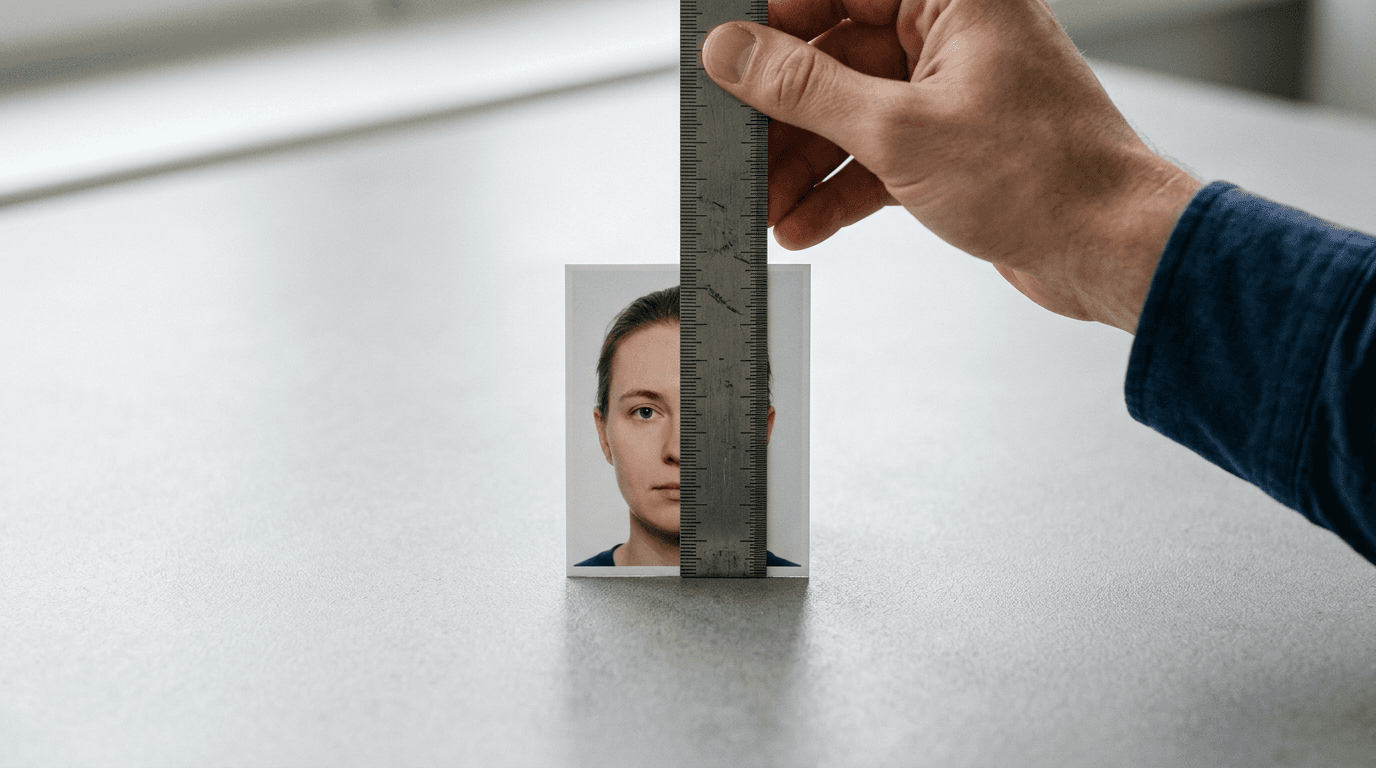
Practical rule: Measure the distance from the bottom of the chin to the crown of the head in your printed photo; if it falls outside the 32-36mm range, the biometric scanner will automatically fail it regardless of image clarity.
If you are struggling with the specific biometric markers for European applications, reviewing the comprehensive UK & International Baby Passport Photo Requirements & Guides can clarify exactly where the nodal points must align.
How the Spain visa photo size dictates framing
When calculating the passport photo size Spain demands, applicants often focus exclusively on the external crop - the 35mm width and 45mm height. However, the external dimensions are merely the container. The true constraint is the internal framing. Spanish consulates require the applicant's face to occupy the vast majority of the photograph's total area.
This creates a narrow window for error. If the camera is placed too close, the face exceeds the 36mm maximum height limit, triggering a rejection for improper proportions. If the camera is too far away, the face drops below the 32mm minimum, causing the biometric software to read the subject as too small to extract reliable facial mapping data.
The impact of focal length on facial distortion
Framing is not merely about distance; it is about the lens used. Smartphone cameras typically use wide-angle lenses (around 24mm to 28mm equivalent). When brought close enough to a subject to fill the vast majority of a 35x45mm frame, a wide-angle lens distorts the face, enlarging the nose and pushing the ears back. This "barrel distortion" alters the geometric distance between the eyes and the ears, which the Spanish biometric system interprets as an invalid facial map. To achieve the correct Spain visa photo size without distortion, the camera must be positioned at least 1.5 metres away from the subject, using a telephoto setting (typically a 2x or 3x optical zoom on modern devices) to crop in tightly.
Where the Italy passport photo size breaks standard templates
The Italy passport photo size shares the 35x45mm external dimensions of its Schengen neighbours, but the Italian consulate applies distinct scrutiny to the upper boundary of the photograph. Italian requirements stipulate a specific gap between the crown of the head and the top edge of the photograph - usually 2mm to 4mm.
Many automated photo booths and generic cropping tools place the head squarely in the centre of the frame, often clipping the top of the hair or leaving too much dead space above the head. If the crown (ignoring voluminous hair) touches the top edge of the cut photograph, the Italian authorities will reject it. They require this margin to ensure the biometric scanner can establish a clear baseline for the top of the skull.
Navigating the background contrast requirement
Italy also strictly enforces the background rule. While some countries accept pale grey or cream, the Italian standard heavily favours a pure, stark white background with zero texture. Any visible grain, shadow from the subject's shoulders, or gradient caused by uneven room lighting will compromise the scan. Ensuring a pure white background without overexposing the subject's face requires balancing ambient light with direct illumination. If you need a reliable method to strip out non-compliant backgrounds and enforce these margins, utilising a dedicated UK Baby Passport Photo Maker can standardise the output against the strict 35x45mm template.
What happens when infant proportions meet adult rules
The most significant friction point in European travel documentation occurs when photographing infants. The rules for the spanish passport photo size were written for adult bone structure, where the neck supports the head vertically and the eyes remain open and focused forward. Infants, particularly newborns, lack the cervical strength to sit upright, meaning they must be photographed lying down or in a supported seat.
When a parent lays an infant on a white sheet, gravity pulls the facial tissue backward, altering the jawline. Furthermore, keeping the infant's eyes open and looking directly at the lens is notoriously difficult. Spanish and Italian consulates offer slight leniency for newborns regarding neutral expressions - a slightly open mouth is usually permitted for babies under one year old - but they offer zero leniency for structural interference.
The prohibition of support structures
If a parent's hand is visible supporting the infant's neck, the photo will be rejected. If the straps of a car seat creep into the frame, the photo is void. If a dummy (pacifier) obscures the mouth, the biometric scan fails. The background must remain uniformly white, meaning any creases in the blanket beneath the baby will be read as background texture.
Practical rule: Photograph infants from above while they lie on a flat, freshly ironed white poster board, ensuring your own body does not cast a shadow over their face during the exposure.
Because infant compliance is so challenging, relying on a service with a 100% Refund Policy allows parents to submit their applications with the financial security that a technical rejection will not result in wasted expenditure.
How background colours trigger automatic rejections
The requirement for a "white or off-white" background is the most frequently misunderstood specification in the entire application process. In the context of biometric photography, "white" does not mean a cream-coloured living room wall or a white door with wood grain showing through. It means a mathematically neutral, featureless expanse that provides maximum contrast against the subject's skin and clothing.

When the biometric software scans the image, it establishes a bounding box around the subject's silhouette. If the background contains a shadow cast by the subject's head, the software may interpret the shadow as part of the subject's hair, artificially widening the head measurement and causing a rejection.
The physics of background separation
To achieve true separation, the background must be illuminated independently of the subject. In a professional studio, this is done with a dedicated strobe pointed directly at the backdrop. At home, achieving this requires placing the subject at least half a metre away from the wall to let the shadow fall out of the camera's frame, while relying on bright, diffuse window light to illuminate both the face and the wall evenly.
If you run into persistent issues with background shadows failing consulate checks, consulting the Help Center for specific lighting configurations can prevent repeated embassy trips.
When to print and when to submit digital files
The final hurdle in the application process is format delivery. While Spain and Italy are transitioning toward digital uploads for certain visa classes and renewals, physical prints remain mandatory for initial passport applications and many consular services. The physical print introduces a new variable: photographic paper specifications.
The danger of retail photo kiosks
Both the Italian and Spanish consulates require photographs to be printed on high-quality, continuous-tone photographic paper. Inkjet prints produced on standard home printers are instantly rejected due to visible dot patterns (dithering) that interfere with the biometric scanner's optical character recognition.
Furthermore, the paper must be glossy or semi-glossy, never matte, and free from ink smudges or physical damage. When applicants use standard retail print kiosks to print a 35x45mm file, the kiosk software often applies a default "auto-enhance" or sharpening filter. This artificial sharpening creates micro-halos around the high-contrast edges of the eyes and jawline, which the consulate software reads as digital manipulation.
| Specification | Italy Passport | Spain Visa | Common Failure Mode |
|---|---|---|---|
| Dimensions | 35x45mm | 35x45mm | Printed at 2x2 inches by mistake. |
| Face Height | 32-36mm | 32-36mm | Camera positioned too close, distorting face. |
| Background | Pure White | White/Light Grey | Shadows cast on the wall behind subject. |
| Print Quality | Min 600 DPI | Min 600 DPI | Home inkjet printer dot patterns visible. |
| Expression | Strictly Neutral | Strictly Neutral | Smiling or infant dummies obscuring mouth. |
To avoid these artificial enhancements, digital files should be formatted onto a standard 4x6 inch template containing multiple 35x45mm crops. This forces the retail kiosk to treat the image as a standard landscape photo, bypassing the ID-photo auto-correction algorithms.
FAQ
Can I wear glasses in an Italian passport photo?
While technically permitted if the frames do not obscure the eyes and there is absolutely no glare on the lenses, the vast majority of applications with glasses are rejected due to micro-reflections. It is heavily advised to remove all eyewear.
Does a Spanish visa require a different photo size than a passport?
No. The Spain visa photo size is identical to the standard Schengen passport requirement of 35x45mm with the face occupying 70-80% of the frame.
How recent must the photograph be for European applications?
Both Italy and Spain require photographs to have been taken within the last six months. If your appearance has changed significantly (e.g., significant weight loss or facial trauma), a newer photo is required regardless of the timeframe.
Are home-printed photos acceptable for Italian citizenship applications?
No. Home inkjet printers leave a microscopic dot pattern that interferes with consular scanning equipment. Photos must be printed on continuous-tone photographic paper via dye-sublimation or traditional photochemical processes.