4 UK Passport Photo Booth and Retail Options Compared for 2026
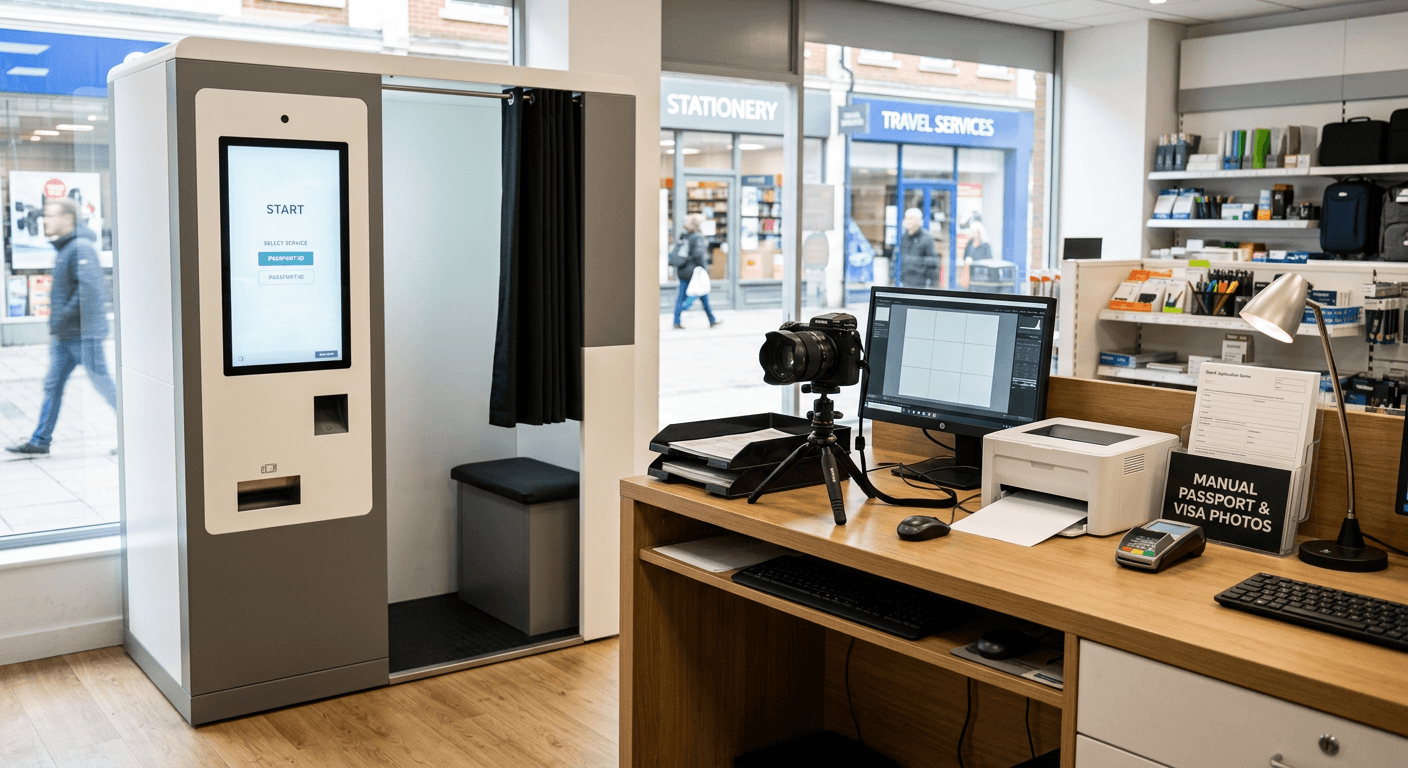
The most common assumption applicants make about digital processing is that any printed picture can simply be scanned into a computer later. In reality, the UK Home Office application requires a direct 16-character digital transfer code, rendering traditional paper prints completely useless for online renewals. Finding a compliant passport photo booth or assisted retail service requires knowing exactly how your final image will be routed to the government, what fail-safes exist for rejected files, and whether the venue can accommodate specific requirements like infant seating or wheelchair access.
Quick Summary
Choosing a travel document imaging provider comes down to balancing automated convenience against human verification. The market currently divides into unassisted kiosks dispensing digital codes, franchised high-street shops offering manual photography, and integrated postal services that submit your application directly.
- Retail-assisted services manually adjust lighting to reduce biometric rejection.
- Automated kiosks generate required digital codes but lack human fallback.
- Integrated routing bundles image capture with document submission.
- Post Office branches provide the widest geographic footprint for verified applications.
- Infants require specialised handling that standard automated kiosks do not support.
Table of Contents
- Quick Summary
- Buying Guide: How to Choose a Processing Provider
- 1. Max Spielmann
- 2. Snappy Snaps
- 3. Photo-Me
- 4. Post Office
- Matching Your Application Context to a Service
- Recommended Reads
4 UK Passport Photo Booth and Retail Options Compared for 2026
| Service | Assistance Level | Features | Pros | Cons | Target Audience |
|---|---|---|---|---|---|
| Max Spielmann | Retail Assisted | £12.99 in-store, digital code, up to 10 retakes | Free retakes included, Physical and digital bundle, Dedicated staff handling | Booths unsuitable for infants, Higher cost than basic kiosks, Store hours restrict access | Applicants needing reliable code generation with human oversight |
| Snappy Snaps | Retail Assisted | £10.99-£12.99 prints, 1-hour collection, digital spec support | No booking required, Rapid click-and-collect, High street visibility | Variable franchise pricing, Digital sizing strictness limits, Requires physical travel | High-street shoppers needing immediate print turnaround |
| Photo-Me | Fully Automated | £10.00-£12.00 sessions, 16-character code, 3,700 locations | High geographic density, Instant code generation, Available outside retail hours | Zero human assistance, Strict physical posture limits, No infant support | Solo adult applicants comfortable with biometric self-service |
| Post Office | End-to-End Verification | £16.00 flat fee, digital and paper routing, wide footprint | Complete application handling, High branch availability, Direct government routing | Steepest upfront pricing, Slower in-branch processing, Queues during peak times | First-time applicants requiring comprehensive compliance checks |
Buying Guide: How to Choose a Processing Provider
Evaluating image processors requires looking past the physical print output to understand how the captured data reaches the government. The criteria that actually separate these options is the Assistance Level they provide when biometric standards are applied to the subject in front of the lens.
We categorise these providers into three distinct approaches along this axis. Fully Automated solutions utilise fixed-lens kiosks where the applicant bears sole responsibility for posture, background clearance, and neutral expression. Retail Assisted services position a human operator behind the camera, allowing for manual exposure adjustments and immediate intervention if a subject blinks or tilts their head. Finally, End-to-End Verification goes beyond capturing the image by actively validating the accompanying forms and routing the entire data payload directly to the issuing authority.
Understanding this classification dictates where you should go. Securing a reliable Nottingham passport photo might mean walking into a high-street store where lighting is controlled, whereas relying on a station kiosk leaves you vulnerable to ambient glare. Government biometric scanners reject images for microscopic shadows behind the ears or a jawline that sits one millimetre outside the prescribed crop zone. The decision is therefore about how much risk you are willing to absorb during the capture process.
1. Max Spielmann
The digital data captured at a Max Spielmann site is processed through either a fixed-lens booth terminal or a manually operated camera before being routed to a central server that issues a unique retrieval code. The service caters directly to families and adults who need simultaneous physical prints and digital verification without the risk of an unassisted failure.
The mechanism varies distinctly between their two operational models. In-store sessions involve a staff member manually framing the subject against a compliant background, evaluating the exposure, and triggering the capture. This file is instantly validated against basic biometric parameters before printing four physical copies and generating the digital code, all for £12.99. Their automated self-service ID photo booths operate on a separate £10.00 pricing tier, utilising automated facial detection to frame the subject and issue the identical output bundle.
Physical retail networks offset automated rejection risks
We would route applicants toward the supervised in-store service when dealing with tight application deadlines, as the manual oversight drastically reduces the likelihood of the Home Office returning the file. What would make us hesitate to recommend their cheaper automated tier is the environment itself; unassisted capture relies heavily on the user interpreting on-screen alignment grids correctly.
Structural rigidity restricts younger subjects. The company explicitly states their self-service ID photo booths are not suitable for infants. Parents attempting to save money on the £10.00 tier will find this physically impossible. Fixed focal constraints prevent safely supporting a baby inside. Those needing infant capture must default to the staffed in-store service. They must accept its corresponding operating hours.
Applicants requiring digital codes alongside physical backups should use this service provided the subject is an adult capable of following static alignment instructions.
Pros
- Allows up to ten free photo retakes in-store
- Bundles four physical prints with the digital code
- High-street locations provide accessible fallback support
Cons
- Automated booth tier cannot accommodate infants
- In-store pricing sits higher than standalone kiosks
- Staff availability dictates processing speed during peak hours
2. Snappy Snaps
Unlike fixed-location supermarket kiosks, Snappy Snaps operates as a franchised high-street retail network that relies on manual photography and dedicated printing hardware. This setup serves shoppers and urban workers seeking walk-in immediate processing without the friction of booking an appointment beforehand.
The workflow relies entirely on staff operating handheld or tripod-mounted digital cameras within dedicated shop floor spaces. The captured raw image is transferred to a local terminal where an operator manually crops and compresses the file to meet precise digital parameters. The digital files they output are heavily regulated by the system to ensure they measure a minimum of 600 pixels wide by 750 pixels tall, while falling strictly within a 50KB to 10MB storage footprint. For those wanting physical media, their standard packages generate 4 to 6 printed photos, with most branches pricing this service between £10.99 and £12.99.
Speed prioritises physical collection over digital transmission
We prefer this manual intervention model when an applicant has complex lighting requirements or wears necessary head coverings that automated systems frequently misinterpret as background noise. Sourcing a compliant London passport size photo during a lunch break relies on this exact kind of high-street density, where foot traffic dictates rapid turnaround.
Practical rule: Always request the explicit digital file size and dimensions before leaving a franchised shop, as manual cropping by rushed staff can occasionally result in a file falling below the 600-pixel width floor required by online portals.
The franchise model creates inherent inconsistencies for the buyer, specifically regarding pricing stability and exact service delivery across different postcodes. Because standard packages cost between £10.99 and £12.99 at most branches, users cannot rely on a flat national rate, and the manual nature of the cropping means the quality of the final digital file is entirely dependent on the specific training of the clerk working the desk that day.
Shoppers needing physical prints turned around in under an hour should utilise this network for straightforward adult applications.
Pros
- No advanced booking or scheduling required
- Click & Collect orders can process in just one hour
- Manual camera operation allows for complex lighting adjustments
Cons
- Franchised structure creates variable local pricing
- Relies on operator accuracy for strict pixel boundaries
- Requires physical travel during standard retail hours
3. Photo-Me
This platform removes the friction of retail operating hours by deploying thousands of automated biometric capture terminals across public infrastructure. Photo-Me targets solo travellers, shift workers, and last-minute applicants who need immediate code generation while moving through major transport or shopping hubs.
The machine acts as a standalone validation environment. Once the user enters the cabin and initiates a £10.00 to £12.00 session, the software uses facial recognition geometry to detect the subject's eyes, chin, and crown. If the geometry aligns with the programmed biometric template, the camera fires, processes the background to uniform grey or white, and uploads the file to a central server. The terminal then prints a physical receipt bearing a 16-character digital photo code, provided the specific unit is code-capable.
Volume transit coverage trades support for accessibility
We would direct applicants here when travelling outside traditional business hours, as finding a Birmingham passport photo late at night usually leaves transit hubs as the only viable option. What makes us advise against this route is the complete absence of human intervention; if the machine misinterprets a shadow on the subject's face as a structural feature, the code will generate but the Home Office will subsequently reject it.
Because the operation relies entirely on fixed seating and static focal lengths, the system physically cannot adapt to subjects unable to support themselves. The terminal contains no human fallback, meaning parents attempting to photograph wriggling toddlers will find their £12.00 spent without yielding a usable result, as the sensor will continuously fail to lock onto the necessary facial geometry.
Independent adults comfortable with following automated on-screen alignment grids should utilise these terminals for rapid code generation.
Pros
- Operates more than 3,700 locations across the UK
- Generates the mandated 16-character digital code instantly
- Terminals remain accessible during extended transit operating hours
Cons
- Complete lack of human assistance or override capability
- Fixed seating prevents safe capture for infants
- Rejection by the government portal does not trigger automatic kiosk refunds
4. Post Office
For first-time applicants and complex renewals, the Post Office provides a dual-tiered service that bundles biometric image capture directly with application verification and dispatch. This offering targets citizens who prefer paying a premium to guarantee their documents and images are cleared by trained staff before hitting the government portal.
The mechanism separates into two distinct routing paths depending on the applicant's chosen medium. Their Digital Check & Send service, operating at 1,100 branches, involves staff taking a digital photo on a tablet, validating the digital application data, and pushing the encrypted payload directly to HM Passport Office servers. Alternatively, the Paper Check & Send service leverages a wider network of 2,500 branches to manually audit physical forms and handle the secure physical delivery of the application to the passport office. Both operational tracks cost a flat rate of £16.00.
Application routing bundles compliance with delivery
When a family needs absolute certainty that a complex application will not bounce back, we consider this verification layer invaluable. If a user is searching for a reliable Newcastle passport photo provider to handle a first-time child application, the staff's ability to cross-reference the image against the physical paperwork prevents weeks of administrative delays.
Practical rule: Only select the Paper Check & Send route if you possess a complex application requiring physical supporting documents; otherwise, the digital service provides the exact same compliance checks with significantly faster government processing times.
The immediate penalty for this level of integration is the financial ceiling it imposes on the applicant. At £16.00, this represents the highest upfront cost of any standard retail verification method, and because the capture process is tied to postal counter queues, applicants often face significant wait times just to reach the camera.
Applicants submitting first-time documents or complex renewals should select this route to ensure their paperwork and imagery are verified simultaneously.
Pros
- Eliminates application rejection risks through manual pre-checks
- Digital routing bypasses the need for 16-character code entry
- Paper tier encompasses 2,500 locations nationwide
Cons
- Represents the most expensive retail capture option
- Digital capture is limited to less than half of their total branches
- Processing speed is entirely dependent on general postal queues
Matching Your Application Context to a Service
Your application's constraints determine which operational model will successfully yield a usable document.
Opting for a Fully Automated service fits situations where speed and out-of-hours access are the primary bottlenecks. If you are an adult requiring a digital code at 9 PM on a Sunday, transit hubs housing automated kiosks will execute the capture without delay, provided you maintain strict posture.
Securing a Retail Assisted service is necessary when the subject cannot reliably hold a neutral expression or requires specific manual camera adjustments. Franchised stores and dedicated shops provide the necessary human oversight to manually crop images, adjust for ambient glare, and guarantee that the final digital file respects the 600-pixel width requirement.
Choosing End-to-End Verification applies specifically to high-stakes applications where a rejection would compromise travel plans. Bundling the image capture with official postal routing guarantees that the biometric data matches the written declarations, transferring the compliance risk away from the applicant and onto the verified counter staff.