Where to Get an Irish Passport Photo: 5 Verified Services Compared
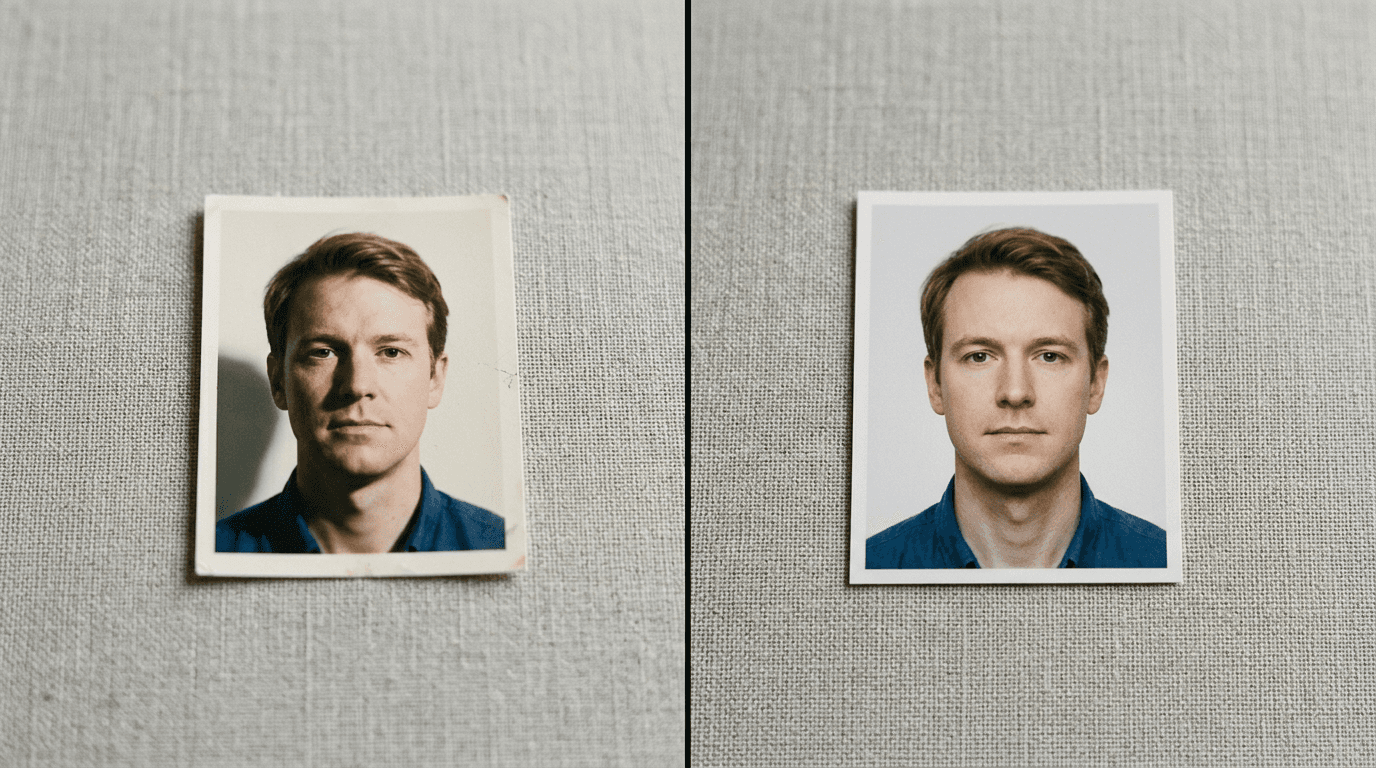
Arranging an infant flat on a plain sheet while desperately trying to capture their face straight-on usually ends with a shadow across the collarbone. That single shadow is enough for an automated biometric system to reject an irish passport photo immediately. Parents and applicants frequently assume the camera is the problem, but the bottleneck is entirely about lighting geometry and background extraction. A standard smartphone lens creates minor perspective distortions, while household lighting introduces uneven contrast that fails official facial recognition checks.
Quick Summary
Evaluating services for travel document imagery requires balancing capture environments against official biometric tolerances. This technical comparison examines how different processing pathways format and verify your portrait data before submission.
- Dedicated studios provide controlled dual-flash lighting to eliminate background shadows.
- Digital platforms utilise algorithmic edge detection to isolate the subject.
- Retail kiosks rely on fixed focal lengths that struggle with postural adjustments.
- Physical paper applications still demand precise die-cut printed dimensions.
Table of Contents
- Quick Summary
- Table of Contents
- Comparison Table
- How to Choose the Right Processing Pathway
- 1. Reload Internet
- 2. Photo-Me
- 3. PhotoAiD
- 4. Timpson
- 5. Post Office
- Matching Your Application to a Pathway
- Recommended Reads
Comparison Table
| Service | Service Delivery Model | Features | Pros | Cons | Target Audience |
|---|---|---|---|---|---|
| Reload Internet | Dedicated Photo Studios | Same-day email delivery, 715 x 951 px resizing | Manual operator oversight, Studio lighting, Exact pixel mapping | Single physical location, Travel required, Manual email delay | Adult applicants near central London |
| Photo-Me | Self-Service Kiosks | 5,500+ machines, Dedicated UI option, Digital codes | High availability, Instant processing, Enclosed backdrop | Fixed camera height, Automated flash timing, UK code restrictions | Unassisted adult applicants |
| PhotoAiD | Digital AI Platforms | iOS application, Two-tiered verification, Background removal | Remote capture, Human review layer, Smartphone accessible | Relies on user camera, Dependent on natural light, Subscription risks | Parents photographing infants at home |
| Timpson | Retail Service Counters | Handheld capture, Physical die-cutting, 4 prints supplied | Staff operation, Immediate physical output, Visual checks | Mixed retail lighting, Peak hour rush, Digital integration lacking | Traditional paper applicants |
| Post Office | Retail Service Counters | 11,500 branches, Paper Passport Assist, Digital routing | End-to-end bundling, Secure form handling, Staff guidance | Equipment varies by branch, Queue times, Higher bundled costs | Applicants requiring manual form assistance |
How to Choose the Right Processing Pathway
Securing a compliant image is not about finding the best camera; it is about choosing the appropriate Service Delivery Model for your subject. The mechanism used to capture the image fundamentally dictates how well it meets official specifications. We categorise the current landscape into four distinct delivery architectures.
Dedicated Photo Studios operate physical premises equipped with professional lighting rigs. The primary advantage is the dual-flash setup, which illuminates the subject from the front while simultaneously washing the background with light to erase secondary shadows. This model offers the highest initial image quality but requires travel.
Self-Service Kiosks provide automated, enclosed environments scattered across public transport hubs and supermarkets. The mechanism relies on a fixed camera sensor and a built-in flash behind a diffuser. While fast, the rigid seating and stationary focal length make them highly inflexible for uncooperative subjects or those with mobility constraints.
Digital AI Platforms shift the capture burden to the applicant's own smartphone. The core mechanism is algorithmic: software identifies the subject's outline, maps the biometric points (like the pupils and chin), and digitally replaces the background with a compliant uniform colour. This model allows for continuous retakes, which is crucial when consulting a guide to baby passport photo requirements to ensure a restless infant is aligned correctly.
Retail Service Counters integrate photographic capture into traditional high street shops. Staff use handheld digital cameras against pull-down screens to take the image before routing it through an onsite dye-sublimation printer. Understanding the required ireland passport photo requirements is delegated to the staff member operating the camera, making the outcome highly dependent on individual operator training.
1. Reload Internet
Situated directly opposite London Paddington Station at 197 Praed Street, Reload Internet operates as a professional photo studio and digital imaging service. The core mechanism involves a human operator manually adjusting the focal length and exposure triangle to capture a well-lit source file against a physical backdrop. Following capture, staff use dedicated raster graphics software to digitally crop and resize the raw image.
The service focuses heavily on the technical specifications of international documents. They specifically resize digital files. This meets the exact 715 x 951 pixels parameters required for Irish applications. This manual mapping ensures the vertical distance from the crown of the head to the chin occupies the correct percentage of the frame. They operate a digital delivery workflow. The finalised, resized images are emailed to the applicant on the same day.
Physical premises constrain digital turnaround
Relying on a single retail footprint introduces severe geographical constraints for anyone living outside central London. Furthermore, while the digital resizing is precise, relying on an asynchronous email delivery system for the final file breaks the continuity of an immediate online application. If the emailed file bounces or is caught in a spam filter, the applicant's workflow halts entirely until the studio resolves the communication error.
We would bypass this physical studio if the applicant is a newborn or dependent requiring complex travel arrangements just to reach Paddington. The logistical friction of transporting an infant outweighs the benefit of manual studio lighting.
Opt for this dedicated studio service when you are already commuting through central London and require manual oversight to correct complex glare on prescription eyewear.
Pros
- Professional dual-flash studio lighting
- Manual cropping to exact pixel dimensions
- Immediate operator feedback during capture
Cons
- Restricted to a single London address
- Email delivery introduces workflow delays
- Travel required for physical capture
2. Photo-Me
Removing the bottleneck of waiting for available retail staff, Photo-Me operates a vast network of self-service photobooths providing instant biometric ID capture. Managed by ME Group, the infrastructure spans over 5,500 machines deployed across the United Kingdom. The mechanism relies entirely on an enclosed, automated capture environment. The user enters the booth, adjusts a motorised stool to align their eyes with a digital overlay on the screen, and triggers a timed exposure.

Selected photobooths feature a dedicated Irish passport option within their touchscreen interface. Choosing this dictates how the internal software crops the resulting image and generates a digital code. It is critical to navigate this menu correctly; a digital photo code generated specifically for a UK passport is restricted at the database level and only works on the GOV.UK portal. The machine communicates via a secure API to lodge the image on a central server, printing a physical receipt with the retrieval code.
Unsupervised capture limits postural correction
The complete absence of an operator means the machine cannot warn you if your posture leans slightly or if a collar obscures your jawline. The rigid, fixed height of the camera sensor demands that the subject sit perfectly upright. This structural inflexibility makes the booth environment highly hostile to infants who cannot support their own head weight.
We would hold off on using an automated booth if you wear bulky seasonal clothing, as the tight framing often misinterprets thick collars as part of the facial structure.
Select a self-service machine primarily for straightforward adult applications processed outside of standard retail trading hours.
Pros
- Massive nationwide deployment footprint
- Automated API code generation
- Available outside normal retail hours
Cons
- Fixed camera struggles with varying heights
- No operator to correct posture errors
- Specific codes are restricted by portal
3. PhotoAiD
When asking whether a mobile device can produce a compliant file, PhotoAiD answers with an AI-powered verification platform accessible via an iOS application on the Apple App Store. Maintaining a 4.6 out of 5-star average across over 13,400 Trustpilot reviews, the system shifts the capture process to the user's own environment.
The technical mechanism operates in two distinct phases. First, the user uploads an image taken with their smartphone. The proprietary algorithm scans the file, automatically excising the background pixels and replacing them with a uniform colour while adjusting the resolution. Second, it employs a two-tiered verification system where the algorithmic processing is followed by a human expert's manual review. This dual layer checks for subtle biometric failures that software often misses, such as uneven pupil dilation or micro-shadows cast by eyelashes.
Practical rule: Always position the subject facing a large window on an overcast day when using algorithmic software; AI cannot digitally recover detail lost to severe optical shadows.
Algorithmic extraction depends on initial sensor quality
No amount of edge-detection software can salvage an inherently blurred photograph. The platform is entirely constrained by the optical capabilities of the smartphone lens used to take the picture and the ambient lighting in the room. Heavy image noise from low-light conditions often confuses the background removal tool, resulting in jagged edges around the hair that official scanning systems flag as manipulation.
We prefer this software approach when photographing toddlers, provided you review a provider's privacy policy to understand how your biometric data is handled post-verification.
Opt for an algorithmic mobile tool when frequent, repeated capture attempts are necessary due to an uncooperative subject.
Pros
- Enables capture in a familiar home setting
- Human review catches algorithmic errors
- Replaces complex backgrounds automatically
Cons
- Wholly dependent on smartphone lens quality
- Low light causes edge-detection failure
- Requires user to understand basic lighting
4. Timpson
Where do applicants turn when they suddenly need immediate physical prints to complete a paper application? They often turn to Timpson. Operating as a high street retail service provider, they offer in-store photographic services alongside their traditional shoe repair and key cutting operations. The capture mechanism is entirely manual. A staff member uses a handheld digital camera. They typically direct the subject to stand against a pull-down white or grey projector screen. This is installed on the shop floor.
The service excels at generating physical deliverables. They print the images using dedicated dye-sublimation hardware, physically die-cutting exactly 4 printed photos to fit within the strict dimensional bracket of 35mm x 45mm up to 38mm x 50mm. During capture, the operator is responsible for enforcing behavioral constraints, manually ensuring a neutral facial expression with a closed mouth and no smiling, which is a hard requirement for Irish passport card photos.
Physical printing enforces rigid dimensional tolerances
The heavy focus on physical print deliverables leaves this pathway poorly integrated with modern, digital-only application routes. Furthermore, capturing images on an active retail shop floor introduces severe lighting contamination. Overhead fluorescent tubes frequently clash with the camera's directional flash, casting secondary, crossed shadows under the nose and chin that the operator may not notice on a small camera preview screen.
We would avoid using a mixed-use retail floor during peak weekend shopping hours, as rushing the manual capture phase frequently results in poor subject alignment.
Rely on a high street retail service when your application mandates physical paper submissions and precise die-cut borders.
Pros
- Immediate production of physical prints
- Staff enforce neutral expression rules
- Exact physical die-cutting provided
Cons
- Mixed ambient lighting causes shadows
- Digital integration is often secondary
- Operator skill varies between branches
5. Post Office
Offering a stark contrast to standalone photographic services, the Post Office operates as the national postal service of the United Kingdom while bundling in-branch ID and application assistance. With over 11,500 branches, the infrastructure is vast. The mechanism here involves staff managing both the photographic capture and the secure routing of the physical application forms.
For applicants navigating complex bureaucracy, they offer a specific Paper Passport Assist service for Irish passport applications, charging a fee of £11 in addition to the standard passport fee. The in-branch digital and printed photo services are priced separately, starting from £16.00. The process works as a chain of custody: the staff capture the image against a designated branch wall, print or digitise the file, and then physically assemble and verify the application paperwork before sealing it for secure transit.
Assisted routing bypasses digital friction
The structural limit of this network is its deep inconsistency. While the postal network is extensive, photo equipment availability varies drastically by location. A local village branch might offer full Paper Passport Assist but lack the dedicated backdrop or calibrated camera required to actually capture the necessary ireland passport photo size, forcing the applicant to source the image elsewhere before returning to post the forms.
We would rigorously check a specific branch's equipment inventory online before committing to an in-person visit for this bundled service. Ensure you understand the 100% refund policy of any provider you use prior to visiting the counter, as paper rejections are costly.
Commit to the postal network pathway when you require end-to-end guidance for securing and routing complex physical documents.
Pros
- Bundles photography with form assistance
- Massive network of local branches
- Secure routing of physical documents
Cons
- Total costs scale higher than isolated services
- Hardware availability is highly inconsistent
- Vulnerable to standard branch queue times
Matching Your Application to a Pathway
The correct choice depends entirely on the subject being photographed and the format required by the receiving embassy.
If your primary hurdle is obtaining an image of a newborn who cannot sit upright, Digital AI Platforms remove the spatial constraints entirely. By allowing you to lay the infant on a flat surface in natural light, the algorithmic extraction handles the complex formatting without requiring travel.
When the bottleneck is speed for an adult applicant comfortable with technology, Self-Service Kiosks offer the fastest route to an API-generated digital code, bypassing retail queues entirely.
For complex cases requiring precision, such as overcoming heavy glare on essential medical eyewear, Dedicated Photo Studios provide the controlled lighting and manual operator oversight necessary to prevent an automated rejection.
Finally, if navigating the bureaucracy of international document submission is daunting, Retail Service Counters bundle the strict physical dimensional requirements with secure form routing, ensuring the exact paper specifications are met before the envelope is sealed.