Why your passport size photo hk fails: Asian biometric standards explained
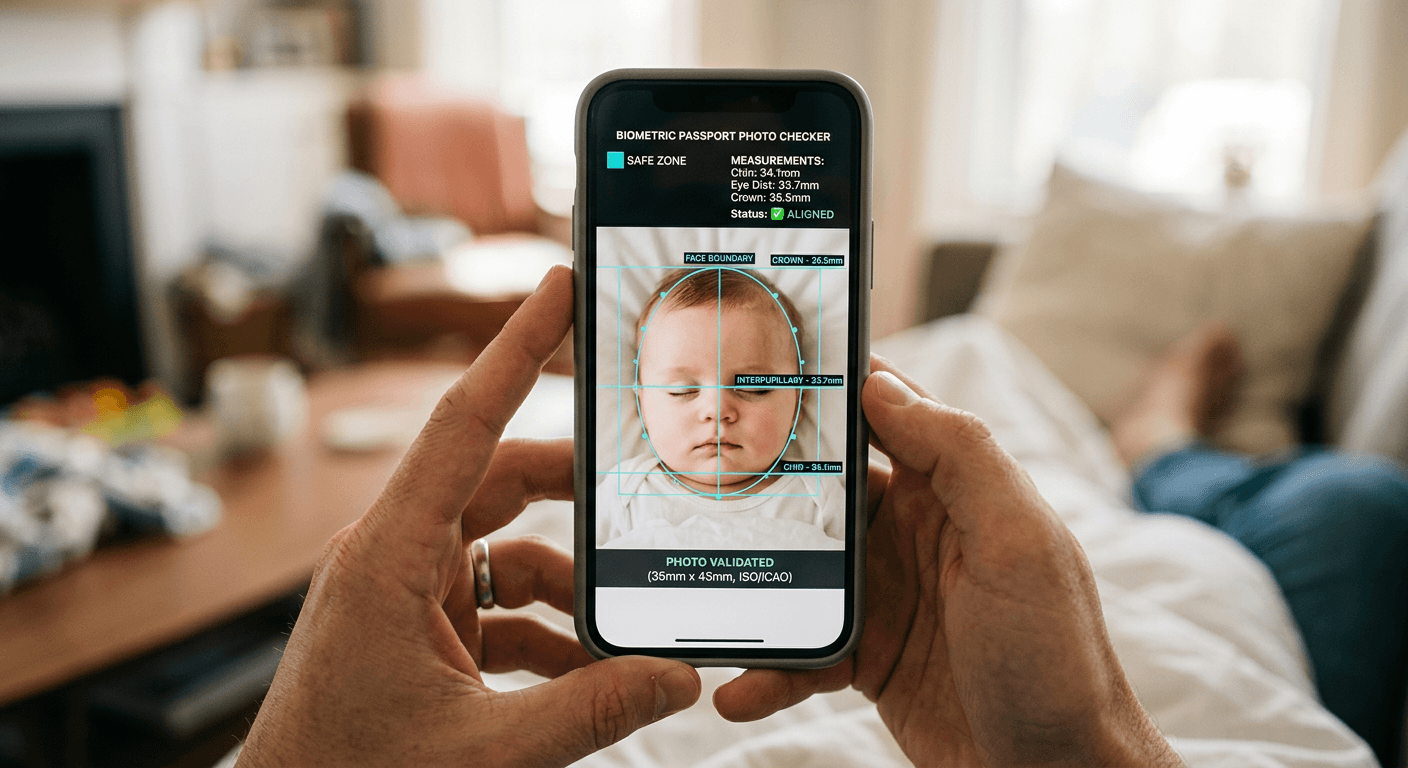
Most applicants assume that an application is rejected because a photograph is too dark or blurry, but the actual failure point is usually geometrical. An applicant walks into a local pharmacy, asks for a standard print, and assumes they have met the requirements because the paper measures correctly. But when applying for international documents, obtaining a passport size photo hk that passes the biometric scanners requires you to look entirely past the outer dimensions and focus on the internal grid. The paper size is just the carrier; the face-to-frame ratio is what the system actually grades.
Quick Summary
Getting a biometric photo accepted relies on matching the strict internal proportions required by facial recognition software, rather than just the physical paper dimensions. A compliant image must align the subject's pupils, chin, and crown within millimetre-precise zones.
- Outer paper dimensions mean nothing if the chin-to-crown ratio is too large or small.
- Different jurisdictions mandate entirely different shoulder-line and clothing contrast rules.
- Smartphone lens distortion will cause automatic rejection if the raw picture is taken too close to the subject.
- Automated processing relies on clear edge detection, making shadow elimination more important than lighting intensity.
Table of Contents
- Why physical dimensions fail as a compliance metric
- How the biometric grid dictates Hong Kong application success
- Where Malaysian clothing rules cause automatic rejections
- How digitisation split the Bangladesh formatting requirements
- Why capturing wide beats framing for the final cut
- What background removal software actually looks for
- Comparison of regional biometric specifications
- FAQ
- Recommended Reads
Why physical dimensions fail as a compliance metric
The most common error in document photography is treating the outer cut of the paper as the primary requirement. When an immigration portal states that an image must be 40 millimetres wide by 50 millimetres high, applicants focus on getting the print cut exactly to those lines.
However, border agency scanning systems do not look at the edges of the paper. They look for the pupillary distance - the gap between the centre of the left and right eyes - and the fixed distance from the bottom of the chin to the crown of the head. These systems overlay an invisible grid onto the uploaded file. If the chin rests on the bottom line of that grid, the eyes must fall precisely within a narrow horizontal band further up.
If you fill the frame too much, the head expands outside the central biometric zone. The scanning software will fail to register the pupillary distance because the eyes sit too high in the grid, prompting an automatic rejection. This is why you cannot simply scale an existing photograph down to fit a smaller rectangle. The head size must be scaled independently of the background.
To prevent this, you have to measure the subject before you measure the crop. You can verify your own files by checking the chin-to-crown measurement against the total height of the image. If the head occupies less than 60 percent or more than 80 percent of the vertical space, the crop is wrong regardless of the outer paper dimensions. For applicants navigating multiple regional variations, consulting the UK & International Baby Passport Photo Requirements & Guides provides the exact millimetre tolerances for these internal grids.
How the biometric grid dictates Hong Kong application success
The requirements for a hong kong passport photo size are notoriously strict because the biometric grid leaves almost no margin for error. The physical photograph must measure 40 millimetres by 50 millimetres, but the critical metric is the head height, which must sit precisely between 32 and 36 millimetres from the chin to the crown.
That four-millimetre tolerance is where the majority of applications fail. When photographing adults, holding a fixed posture within this zone is straightforward. When photographing infants, a slight head tilt backwards artificially shortens the chin-to-crown measurement, pulling the head height below the 32-millimetre minimum threshold.
Furthermore, the background must be plain white, and the subject's features must be completely unobstructed. While immigration officials occasionally show leniency for newborn expressions, the eyes must be open and clearly visible. Any flash reflection in the pupil or red-eye effect alters the dark pixels the algorithm uses to lock onto the eyes, causing the scan to abort.
Practical rule: Never measure the head height to the top of the subject's hair. Biometric software measures to the anatomical crown of the skull. If the subject has voluminous hair, compress it visually to estimate where the actual skull ends before making your crop.
Where Malaysian clothing rules cause automatic rejections
While most systems focus heavily on the face, the malaysia passport photo size requirements introduce a strict clothing contrast rule that routinely catches out applicants. The standard physical dimensions demand a 35-millimetre by 50-millimetre crop, with a head height between 25 and 30 millimetres.
What sets this jurisdiction apart is the absolute requirement for dark clothing covering the shoulders and chest. Because the background must be pure white, the scanning software requires a hard, high-contrast line to define the shoulders and separate the subject from the backdrop. If an applicant wears a white shirt, a light pastel top, or a thin-strapped vest, the software cannot detect the shoulder line. The subject's torso effectively disappears into the background, and the application is rejected automatically.
This is particularly challenging for parents photographing babies, as infant clothing is overwhelmingly pastel or white. You must drape a dark cloth over the child's chest or dress them in a dark, solid-colour top before taking the picture. Additionally, glasses of any kind - even those with clear lenses and no glare - are strictly prohibited. The software must have an uninterrupted view of the orbital bone structure.
How digitisation split the Bangladesh formatting requirements
The transition from Machine Readable Passports (MRPs) to modern e-passports has fractured the rules surrounding the bangladesh passport photo size, creating confusion over which standard to follow.
Historically, the standard physical print required a 40-millimetre by 50-millimetre dimension. However, the introduction of online digital portals for e-passports has introduced different digital aspect ratios. While physical submissions for certain visa classes still rely on the 40x50mm physical print, the digital upload systems often expect a 55-millimetre by 45-millimetre dimension, requiring a completely different crop and head-to-frame ratio.
The background colour rules have also shifted. Older MRP guidelines permitted both white and light blue backgrounds, but the e-passport biometric system now strictly mandates a pure white background. Submitting a perfectly proportioned image with a light blue background into the modern e-passport portal will trigger an immediate compliance failure.
To ensure you do not fail this formatting split, you must check whether you are supplying a digital upload for an e-passport or a physical print for an older visa category, as the aspect ratios cannot simply be stretched to fit one another without distorting the facial geometry.
Why capturing wide beats framing for the final cut
When parents attempt to take compliance photos at home, they usually bring the smartphone camera very close to the subject's face to fill the screen, mimicking the final tight crop they see on an official document. This is a severe mechanical error that guarantees biometric failure.
Smartphone cameras utilise wide-angle lenses, typically sitting at a 24-millimetre or 26-millimetre equivalent focal length. When a wide-angle lens is placed within a few feet of a human face, it causes barrel distortion. The centre of the image bulges outwards, making the nose appear much larger and artificially increasing the distance between the eyes, while the ears are pushed back and often obscured entirely. Biometric software detects this distorted geometry as a non-human or falsified face.
To capture flat, accurate facial geometry, the camera must be placed at least 1.2 to 1.5 metres away from the subject. At this distance, the subject's head will look very small in the frame, surrounded by excessive background space. This is precisely what you want. You capture the accurate, undistorted geometry from a distance, and then rely on formatting software to crop the image down to the required millimetre specifications.
Because the digital process handles the precision cropping, taking the picture from further back is the safest approach. If the software cannot salvage a poorly framed shot, applicants are protected by a 100% Refund Policy | UK Baby Passport Photo Maker on rejected outputs, provided the original image geometry was sound.
Practical rule: Frame the shot so that the subject's head occupies no more than one-third of the screen when taking the photograph. Leave massive amounts of empty space on all sides to allow for digital straightening and cropping later.
What background removal software actually looks for
Automated processing tools have made it possible to remove domestic backgrounds - such as living room walls or high chairs - and replace them with the pure white required by official standards. However, these algorithms do not 'see' the subject; they look for edge contrast.
The mechanism relies on mapping the difference in pixel brightness between the edge of a cheek and the background immediately next to it. If the lighting is uneven, or if the subject casts a hard shadow against the wall behind them, the edge detection fails. A shadow cast on a white wall creates a gradient of dark pixels that the software often misinterprets as part of the subject's hair or jawline. When the background is removed, it leaves an irregular, jagged border around the face.
Immigration scanners are highly sensitive to these irregular edge artifacts. If border software detects a jagged pixel line along the jaw, it flags the image as digitally manipulated or tampered with. To prevent this, the subject must be lit evenly from the front to eliminate cast shadows entirely. Natural, diffuse daylight from a window is far superior to a harsh overhead bulb or a camera flash, both of which create the hard shadows that break background removal algorithms.
Comparison of regional biometric specifications
The table below outlines the distinct mechanical variations between the three jurisdictions discussed, demonstrating why a single master photograph cannot be used across different national applications without re-cropping.
| Specification | Hong Kong | Malaysia | Bangladesh (Standard) |
|---|---|---|---|
| Outer Dimensions | 40 x 50 mm | 35 x 50 mm | 40 x 50 mm (Digital varies) |
| Head Height (Chin to Crown) | 32 - 36 mm | 25 - 30 mm | 70 - 80% of total height |
| Background Colour | Pure White | Pure White | Pure White |
| Critical Unique Rule | Very tight 4mm head size tolerance | Dark clothing covering shoulders strictly required | Digital e-passport aspect ratios differ from physical prints |
FAQ
What is the difference between a visa and passport photo size? While they often use the same source image, visa applications frequently demand different physical crop sizes or digital aspect ratios compared to the country's own domestic passport rules. You cannot assume a compliant domestic photo will work for a foreign visa.
Can I wear glasses in an international biometric photo? In almost all modern jurisdictions, glasses are strictly prohibited. Even if the lenses do not have glare and the frames are thin, the physical frame interrupts the biometric mapping of the orbital bone and eye socket, leading to scanner rejection.
How strict are the head-to-chin ratio measurements? They are absolute. Software, not human officials, conducts the initial scan. If a jurisdiction requires a maximum head height of 36 millimetres and your crop places the head at 37 millimetres, the computer will reject it before a human ever views the application.
Do infant passport photos need the subject's eyes fully open? Yes. While some minor allowances are made for a neutral expression (infants are not expected to hold a perfect closed-mouth pose), the eyes must be visibly open and unobscured so the pupillary distance can be measured by the software.